The World Has Become Too Large to Hold
Modern life unfolds at a scale too vast for human hands. This essay argues that repair cannot begin in the large world, it must begin in the small one, where identity, responsibility, and belonging are actually formed.
I. Opening: A World That Has Outgrown Human Hands
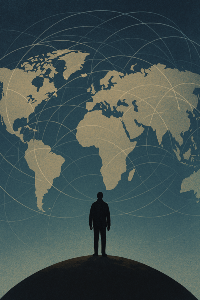
The modern world asks ordinary people to carry scales of information, responsibility, and anxiety that no human being was built to hold. Life unfolds across vast systems...global markets, national politics, digital networks, planetary crises...all operating far beyond the reach of any individual. People wake up each morning already overwhelmed by events happening thousands of miles away, yet disconnected from the people living twenty feet from their door.
The result is a quiet, pervasive disorientation. The world feels too large to understand, too fast to follow, too chaotic to influence. We are expected to care about everything while belonging to almost nothing. The scale of modern life has expanded far beyond the human hand, the human mind, and the human heart.
But human beings were never meant to live at this altitude. We are creatures of proximity...shaped by the people we know, the places we inhabit, the work we do with others, the rhythms and rituals that anchor us. Meaning is not transmitted at global scale. Purpose is not formed in abstraction. Belonging is not found in systems.
This is the central truth from which the entire Small World Series begins:
Repair cannot begin in the large world.
It must begin in the small one, the world close enough to touch.
The small world is where identity is formed, where responsibility is learned, where trust is built, and where purpose takes root. When the small world is strong, the large world becomes navigable. When the small world collapses, the large world becomes unbearable.
This series begins by returning to the scale at which human beings can actually live, act, and repair.
II. Humans Are Built for the Near, the Known, and the Local
Human beings are not designed to live inside vast, abstract systems. We are shaped by what is close: the people we see, the places we inhabit, the work we do with our hands, the rhythms that repeat across days and seasons. For most of human history, life unfolded within a small circle of relationships...family, neighbors, elders, apprentices, and the shared work that bound them together. This was not a limitation. It was the scale at which meaning could be transmitted.
Identity forms through proximity. Children learn who they are by watching the adults around them, absorbing expectations through imitation long before they understand them in words. Responsibility is learned the same way, not through instruction, but through participation in the daily maintenance of life. Belonging emerges from shared rituals, shared burdens, and shared memory. These are not global experiences. They are intimate ones.
The small world is where the human creature becomes capable. It is where people learn to cooperate, to trust, to endure, to contribute. It is where they discover that they matter, not in theory, but in practice. A person who is needed by others becomes someone who can carry weight. A person who is not needed becomes someone who drifts.
When life expands beyond human scale, these formative experiences weaken. Digital networks replace neighbors. Institutions replace relationships. Mobility replaces continuity. People become spectators to their own lives, watching events unfold at a distance rather than participating in the world immediately around them.
The result is a quiet erosion of capability and confidence. Without the small world, people struggle to understand their place in the large one. They feel overwhelmed by its demands and disconnected from its rewards. The human creature was built for the near, the known, and the local and when those foundations weaken, the entire structure of life becomes unstable.
The work of repair begins by returning to the scale at which human beings can actually grow.
III. The Rise of the Large World
The large world did not appear all at once. It expanded gradually, through a series of transformations that stretched life beyond the scale the human creature was built to hold. Each shift brought new possibilities, but each also weakened the structures that once kept people rooted in place.
Industrialization pulled work out of the home and into distant factories. Mobility loosened the ties between families and the places that had shaped them for generations. Mass education replaced apprenticeship with abstraction. National markets replaced local interdependence. Digital networks dissolved the boundaries of time and place entirely, drawing people into a constant stream of information that has no center and no end.
None of this was malicious. Much of it improved material life. But each step enlarged the world faster than human beings could adapt to it. The institutions that once held life at a human scale...family, neighborhood, craft, tradition...were not designed to compete with systems operating at continental or global reach. As the large world grew, the small world thinned.
People now live inside structures they cannot see and cannot influence. Their food comes from supply chains that span oceans. Their work depends on markets they will never visit. Their sense of danger and urgency is shaped by events occurring thousands of miles away. Their attention is captured by crises they cannot touch and cannot resolve.
The result is a life lived at a scale that overwhelms the human nervous system. The large world demands constant vigilance, constant reaction, constant emotional investment...yet it offers no place to stand, no role to play, no way to contribute meaningfully. It is a world too vast to hold, and too abstract to inhabit.
This is not a call to reject modernity. It is a recognition that the large world cannot be the primary world in which people live their lives. It is too big to form identity, too distant to transmit purpose, too abstract to sustain belonging. The rise of the large world has left people suspended between global demands and local emptiness.
To repair this imbalance, we must understand what was lost and why the small world remains the only scale at which human beings can truly live.
IV. The Consequence: A Life Lived in Abstraction
As the large world expanded, people found themselves pulled into a way of living that is increasingly detached from the places, relationships, and responsibilities that once gave life coherence. The result is a quiet but profound form of dislocation: a life lived in abstraction.
People now spend more time reacting to distant events than participating in their immediate surroundings. They know the names of global political figures but not the names of their neighbors. They feel responsible for crises unfolding across continents but powerless to influence the conditions of their own communities. Their emotional lives are shaped by news cycles, algorithms, and global narratives rather than by the rhythms of the places they inhabit.
This creates a strange paradox: people feel overwhelmed by the world, yet disconnected from it. They carry the weight of problems they cannot touch while neglecting the relationships and responsibilities that are within reach. The large world demands constant attention, but it offers no belonging. It asks for emotional investment without providing a role to play.
The psychological cost is significant. Anxiety rises when people are asked to care about everything but can act on almost nothing. Loneliness grows when relationships are replaced by networks. Identity weakens when it is no longer anchored in shared work, shared memory, or shared place. Purpose dissolves when life becomes a stream of information rather than a pattern of commitments.
This is not a failure of individuals. It is a mismatch between human nature and the scale of modern life. People were not built to live in abstraction. They were built to live in the small world...the world of family, neighbors, apprenticeships, traditions, and the daily maintenance of life.
When the small world weakens, the large world becomes unbearable. And when the large world becomes unbearable, people retreat into distraction, drift, or despair. The consequence is not merely emotional. It is civilizational. A society cannot be repaired at a scale that overwhelms the people who must repair it.
To understand how to rebuild meaning, we must first understand what the small world provided and why its absence leaves people unanchored.
V. Why Repair Cannot Begin in the Large World
Modern life encourages people to think in terms of national crises, global systems, and institutional failures. The instinct is understandable. When the world feels unstable, people look upward...toward governments, corporations, and large organizations...hoping that someone at a higher level can restore order. But the large world is the least effective place to begin the work of repair.
Large systems cannot transmit meaning. They can distribute resources, enforce rules, and coordinate action, but they cannot give people a sense of identity or belonging. They cannot teach responsibility. They cannot cultivate trust. These are not failures of policy. They are limitations of scale.
The large world is too distant to shape character and too abstract to sustain commitment. It can issue directives, but it cannot form relationships. It can create programs, but it cannot create purpose. It can legislate behavior, but it cannot cultivate virtue. The things that make a society healthy...stability, responsibility, cooperation, continuity...emerge only at the human scale.
This is why attempts to repair society from the top down so often fail. They address symptoms rather than causes. They operate at a scale where the real work of repair cannot occur. A society cannot be rebuilt through national initiatives if the small world beneath it is fractured. No amount of institutional reform can compensate for the absence of strong families, capable adults, stable communities, and shared traditions.
Repair must begin where human beings actually live their lives, in the places close enough to touch. The small world is the only scale at which people can meaningfully act, meaningfully belong, and meaningfully change. It is the only scale where trust can be rebuilt, where responsibility can be learned, and where purpose can take root.
The large world may set the conditions for repair, but it cannot perform the repair itself. That work belongs to the small world, and to the people who inhabit it.
VI. The Small World as the Seedbed of Purpose
Purpose does not emerge from information. It does not come from ideology, or from global awareness, or from abstract commitments to distant causes. Purpose is formed through participation in a world where a person’s actions matter to others, a world small enough for responsibility to be visible, reciprocal, and real.
In the small world, people learn who they are by being needed. A child who helps set the table, stack firewood, or care for a younger sibling discovers that he or she is capable of contributing to the life of the household. An apprentice who works beside a master learns not only a skill, but a sense of identity rooted in competence and continuity. A neighbor who shows up to repair a fence or shovel a driveway becomes part of the moral fabric of the community.
These experiences are not grand or dramatic. They are small, repetitive, and deeply human. They teach people that their presence matters, that their work has weight, and that their lives are woven into the lives of others. This is the foundation of purpose: the knowledge that one’s actions sustain a world that would be poorer without them.
When the small world weakens, this foundation erodes. People may still care about global issues, but they struggle to locate themselves within them. They may feel responsible for everything, yet accountable for nothing. They may seek meaning in distant causes while feeling invisible in their own homes and neighborhoods. Without the daily experience of being needed, purpose becomes fragile.
The small world is where capability is cultivated. It is where responsibility is learned. It is where identity is anchored. It is where people discover that they are not merely observers of life, but participants in its maintenance. A society that neglects the small world deprives its members of the experiences that make them strong, stable, and oriented.
Repair begins by restoring the places where purpose is formed, the places close enough for a person to see the difference they make.
VII. The Moral Argument: Begin With What Is Nearest
Repair is not an abstract project. It is not a national initiative or a global movement. It begins with the smallest, most immediate responsibilities, the people and places close enough for our actions to matter. The moral order of a society is built from the inside out, not the outside in.
A person who cannot repair their home cannot repair their neighborhood.
A neighborhood that cannot sustain itself cannot repair its institutions.
A society that neglects the small world cannot stabilize the large one.
This is not a judgment. It is a sequence.
The small world is where the habits of repair are learned: patience, responsibility, cooperation, endurance, and the quiet willingness to maintain what others depend on. These virtues do not emerge from ideology or policy. They emerge from practice...from showing up for the people who rely on you, from tending to the places that shape you, from participating in the daily maintenance of life.
When people begin with what is nearest, they rediscover their agency. They see the immediate effects of their actions. They learn that repair is not a grand gesture but a pattern of small, repeated commitments. They become capable of carrying weight because they have carried it before.
The large world cannot be repaired by people who feel powerless in their own homes and neighborhoods. But when the small world is restored, when families are stable, communities are connected, apprenticeships are alive, and traditions are practiced...the large world becomes governable again. It becomes something people can influence rather than something that overwhelms them.
The moral argument is simple:
Repair begins with the responsibilities closest to hand.
The small world is not a retreat from the large one.
It is the foundation that makes repair possible.
Here is Section 8, written in the same calm, architectural, dignified voice as the rest of the essay. This is where the opening essay widens its lens again — connecting the argument you’ve just built to the full architecture of the Small World Series. It’s the bridge that tells the reader: this is only the beginning.
VIII. The Bridge to the Rest of the Series
If the world feels too large to hold, it is because the structures that once anchored people at human scale have weakened. The small world...the world of family, apprenticeship, neighborhood, tradition, and shared responsibility...has thinned to the point where many people no longer experience it at all. They live suspended between global demands and local emptiness, overwhelmed by the large world and undernourished by the small one.
The rest of this series explores the architecture of that small world in detail. Each essay examines one of the foundational structures that once gave ordinary people a sense of identity, purpose, and belonging, and shows how their erosion has contributed to the disorientation of modern life.
We begin with family, the first institution and the primary transmitter of identity.
We move to apprenticeship, the ancient pattern through which capability and character are formed.
We examine neighborhood, the moral ecosystem that shapes norms and expectations.
We explore tradition, the accumulated wisdom that stabilizes life across generations.
We consider the gendered architecture of community, the complementary roles through which men and women sustained the small world.
We confront the collapse of these structures, and the consequences for individuals and society.
And finally, we turn toward repair, the work of rebuilding the small world so that the large one becomes livable again.
This series is not nostalgic. It is architectural. It does not argue for a return to the past, but for a return to human scale, to the structures that make people capable, connected, and oriented. The small world is not a sentimental ideal. It is the foundation of civilizational health.
The world may be too large to hold, but the small world is not.
The work of repair begins there.
IX. Closing: A Return to Human Scale
The world has grown too large for any one person to hold, but the answer is not to withdraw from it. The answer is to rebuild the foundations that allow human beings to stand upright within it. A society cannot be repaired at the scale of continents and systems. It can only be repaired at the scale of households, neighborhoods, apprenticeships, and the daily commitments that bind people to one another.
The small world is not a consolation prize. It is the architecture that makes the large world livable. It is where identity is formed, where responsibility is learned, where trust is earned, and where purpose takes root. When the small world is strong, people can face the large world without being overwhelmed by it. When the small world collapses, even the most capable individuals struggle to find their place.
The work of repair begins by returning to the scale at which human beings can actually live. It begins with the people closest to us, the places that shape us, and the responsibilities that depend on us. It begins with the small world, the world we can touch, tend, and sustain.
The rest of this series explores that world in detail. It examines the institutions, relationships, and traditions that once held life together, and it traces the consequences of their erosion. It also points toward the path of renewal: a return to human scale, to shared responsibility, and to the quiet, steady work of maintaining the world we inhabit.
The world may be too large to hold.
But the small world is not.
And it is there, in the places nearest to us, that repair begins.