The Virtues of the Craftsman
A craftsman is not defined by his tools but by his virtues, patience, precision, humility, and endurance. These interior qualities form the scaffolding of competence and the character required to carry weight with dignity. The Forge restores the virtues that make mastery possible.
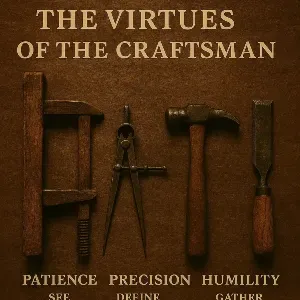
A craftsman is not defined by his tools. He is defined by his virtues.
A craftsman is not defined by his tools.
He is defined by his virtues.
Tools can be bought.
Skills can be taught.
But the interior qualities that make a man capable of steady, dignified work, those must be forged.
If The Weight a Man Must Carry named responsibility, this essay names the character required to carry it well.
I. Craftsmanship as a Moral Posture
Craftsmanship is not merely technical.
It is ethical.
A craftsman approaches the world with a posture of:
- care
- precision
- patience
- humility
- responsibility
He does not rush.
He does not cut corners.
He does not hide flaws.
He does not pretend.
He works in a way that honors the thing being made and the person he is becoming.
II. The Four Core Virtues of the Craftsman
1. Patience
Good work takes time.
A craftsman resists the modern impulse toward speed, novelty, and instant results.
Patience is not passivity.
It is disciplined endurance, the willingness to stay with a task until it is right.
2. Precision
A craftsman pays attention.
He notices the millimeter, the angle, the fit, the finish.
Precision is not perfectionism.
It is respect, for the material, for the craft, for the outcome.
3. Humility
A craftsman knows his limits.
He listens to mentors, honors tradition, and accepts correction.
Humility is not self‑erasure.
It is openness, the recognition that mastery requires submission to something greater than oneself.
4. Endurance
A craftsman keeps going.
He works through fatigue, frustration, and failure.
Endurance is not stubbornness.
It is fidelity, the commitment to finish what he began.
These virtues are not optional.
They are the interior scaffolding of competence.
III. The Modern Erosion of Craft
Our age rewards:
- speed over depth
- novelty over mastery
- spectacle over substance
- shortcuts over skill
- self‑promotion over quiet competence
The result is a generation of men who feel busy but unformed active but unanchored.
Craft restores what speed erodes.
IV. How Virtue Shapes Skill
Skill without virtue becomes:
- sloppy
- brittle
- arrogant
- inconsistent
Virtue without skill becomes:
- sentimental
- ineffective
- untested
A craftsman needs both.
Virtue gives skill its integrity.
Skill gives virtue its expression.
V. The Foundry’s Mandate
The Foundry exists to restore the virtues of craftsmanship, not as nostalgia, but as necessity.
We believe:
- Craft is character made visible.
- Virtue is the foundation of competence.
- Mastery requires patience, precision, humility, and endurance.
- A man becomes a craftsman from the inside out.
- These virtues are not theoretical. They are practical, repeatable, and within reach.
This is the work ahead.
This is the work of The Forge.