The Social Infrastructure
The small world once formed citizens, held communities together, and sustained civic life. Its collapse left behind loneliness, fragility, and fragmentation and no visible system can replace what was lost. Repair begins with proximity, patience, and care.
I. The World Beneath the World
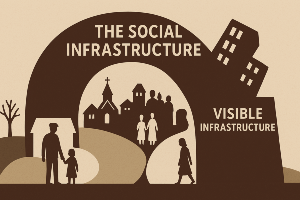
Every healthy society rests on two infrastructures. One is visible: roads, power lines, water systems, the machinery that keeps a nation running. The other is quieter, older, and far more fragile. It is the network of families, neighborhoods, churches, clubs, and local institutions that once held people in relationship with one another. This second structure, the social infrastructure, is the world beneath the world. It is the architecture that teaches people how to live, how to belong, and how to take responsibility for one another.
For most of American history, this social infrastructure was not an abstraction. It was a lived environment. Children grew up inside dense networks of adults who knew them. Neighbors depended on one another. Churches and civic groups provided rhythm and meaning. Families were embedded in communities that stretched across generations. Life was local, relational, and anchored.
This small world did not merely support society; it formed it. It shaped character, transmitted norms, and created the trust that made everything else possible. It was the training ground for adulthood and the quiet engine of civic life. Without it, the visible infrastructure, the roads, the grids, the institutions, cannot function for long. A society can survive technical failures. It cannot survive the collapse of the world that teaches people how to be human.
For a time, this small world was strong. It was not perfect, but it was thick, stable, and capable of absorbing shocks. It gave people a place to stand. It gave communities the ability to repair themselves. It gave the nation a foundation.
And then, slowly, it began to erode.
II. How the Social Infrastructure Worked
The social infrastructure was not a single institution. It was an ecosystem...a network of overlapping roles, expectations, and relationships that formed people long before any formal system touched them. Its strength came from density: many small interactions, repeated across time, layered into a coherent world.
At the center of this ecosystem was the household, not as a private retreat but as a civic unit. Families were embedded in neighborhoods where people knew one another, relied on one another, and carried a shared sense of responsibility. Children grew up surrounded by adults who were not their parents, but who still had standing in their lives. Elders were not isolated; they were anchors. The community was not an idea; it was a daily reality.
Around the household stood the institutions that gave the small world its shape. Churches provided moral formation and social cohesion. Schools were local and relational, tied to the community rather than abstract systems. Civic groups, from women’s clubs to fraternal lodges to volunteer associations, created webs of belonging and obligation. These organizations were not hobbies. They were the connective tissue of society.
The social infrastructure also carried a quiet division of labor. Men and women both held civic responsibilities, but in different domains. Men tended the visible infrastructure...the trades, the physical maintenance of the community, the public-facing work. Women tended the social infrastructure...the relationships, the norms, the care networks, the moral ecology. Together, these roles created a balanced world in which the community could sustain itself.
What made the social infrastructure powerful was not its size but its proximity. Life happened face-to-face. Problems were addressed before they became crises. People learned how to behave because they were seen, known, and accountable. Trust was not a slogan; it was the natural result of living in a world where everyone’s life touched everyone else’s.
This was the machinery that formed citizens. It taught cooperation, restraint, responsibility, and care. It gave people a place to belong and a role to play. It created the conditions in which the visible infrastructure, the economy, the institutions, the nation, could function.
And for a long time, it worked.
III. What the Social Infrastructure Provided
The strength of the social infrastructure was not measured in statistics or programs. It was measured in the kind of people it formed and the kind of communities it made possible. Its gifts were quiet, cumulative, and often invisible, the sort of benefits a society only notices when they are gone.
It provided formation.
Children grew up inside a web of expectations that taught them how to behave, how to speak, how to take responsibility, and how to care for others. They learned these things not through formal instruction but through immersion in a world where adults modeled them daily. The small world produced citizens long before the state ever touched them.
It provided stability.
Families were not isolated units but parts of a larger whole. When someone faltered, the community absorbed the shock. When a crisis struck, neighbors responded before institutions did. This distributed resilience made life less fragile and made people less alone.
It provided belonging.
Identity was not something individuals had to construct from scratch. It was inherited, shared, and reinforced by the rhythms of community life. People knew where they came from, who they were connected to, and what was expected of them. This belonging was not restrictive; it was grounding.
It provided accountability.
In a world where everyone’s life touched everyone else’s, behavior mattered. People were seen. Their choices had consequences. This visibility created a natural form of social regulation that kept communities healthy without heavy-handed intervention.
It provided meaning.
The small world offered roles that mattered, not because they were glamorous, but because they were necessary. Raising children, maintaining households, tending neighborhoods, serving in civic groups, supporting churches...these were not private tasks. They were contributions to the common good.
It provided continuity.
Traditions, stories, and norms passed from one generation to the next. The social infrastructure acted as a memory system, preserving the wisdom of the past and transmitting it forward. This continuity gave people a sense of time, place, and purpose.
Together, these gifts created a society that could sustain itself. The visible infrastructure...the economy, the institutions, the nation...rested on this deeper foundation. When the social infrastructure was strong, the country was strong. When it weakened, everything else began to strain.
And in the middle of the twentieth century, that strain began to show.
IV. The Early Signs of Erosion
The small world did not collapse suddenly. It weakened the way most civilizations weaken: quietly, gradually, and long before anyone recognized what was happening. Through most of the 1950s, the social infrastructure still appeared strong. Families were intact, neighborhoods were stable, churches were full, and civic groups remained central to community life. But beneath that surface, the first structural shifts had already begun.
The postwar economy introduced a new level of mobility. Millions of families left the towns and neighborhoods that had anchored them for generations and moved into newly built suburbs. These places offered comfort and opportunity, but they lacked the density and interdependence that had defined earlier community life. The physical distance between people widened, and with it, the social distance.
Television entered the home and quietly replaced many of the communal rhythms that once brought people together. Evenings that had been spent on porches, in church basements, or in civic halls were now spent in front of a screen. The shared life of the neighborhood began to thin, replaced by a private life oriented around entertainment rather than participation.
Extended families, once the backbone of the small world, began to disperse. Economic mobility pulled young adults away from their parents and grandparents. The intergenerational continuity that had once provided stability and memory weakened. The household became more isolated, more nuclear, and more fragile.
None of these changes were dramatic on their own. Each seemed like progress, or at least like a natural evolution of modern life. But together, they marked the beginning of a slow shift away from the dense, relational world that had formed citizens for generations. The small world was still standing, but its foundations were beginning to move.
The country did not yet feel the consequences. That would come later. But by the end of the 1950s, the erosion had begun.
V. The Acceleration of Collapse
By the early 1960s, the small world was no longer merely under strain. The forces that had begun quietly in the late 1950s gathered speed, converging into a decade of rapid and irreversible change. What had once been subtle shifts in the foundations became visible fractures in the structure itself.
The first acceleration came from mobility. Millions of Americans moved not just across towns but across states, chasing opportunity in a national economy that no longer depended on local roots. Neighborhoods became transient. Extended families scattered. The intergenerational continuity that had anchored the small world weakened further, leaving households more isolated than ever before.
At the same time, the rhythms of daily life changed. Television, once a novelty, became the dominant evening activity. The communal spaces that had shaped civic life, porches, church halls, neighborhood gatherings, were replaced by private entertainment. The shared life of the community thinned as people spent more time inside their homes and less time in the relational spaces that had once formed them.
Economic pressures also shifted. The rising cost of living and the changing structure of the labor market made the single‑income household less stable. More families began to rely on two incomes, not as a choice but as a necessity. This altered the daily patterns of family life and reduced the time available for the civic and relational work that had sustained the small world.
Civic institutions, once the backbone of community life, began to hollow out. Churches saw declining attendance. Fraternal organizations and women’s clubs lost members. Volunteer associations struggled to maintain participation. These institutions had been the scaffolding of the social infrastructure, and their weakening left communities without the structures that had once held them together.
Cultural norms shifted as well. The emphasis on individual autonomy grew stronger, while the shared expectations that had governed community life grew weaker. The social scripts that once guided behavior...how to court, how to marry, how to raise children, how to be a neighbor...became less clear and less binding. The small world depended on these shared norms. Without them, its coherence began to unravel.
None of these changes were isolated. They reinforced one another, accelerating the decline of the relational world that had formed citizens for generations. By the end of the 1960s, the small world was no longer the default environment of American life. It was becoming the exception.
The country had entered a new era, one in which the visible infrastructure remained strong, but the invisible one was beginning to fail.
VI. The Consequences of Collapse
When the social infrastructure weakened, the effects were not immediate. For a time, the visible world continued to function. The economy grew. Institutions expanded. Technology advanced. From a distance, it appeared as though society was progressing. But underneath, the quiet machinery that had formed citizens and held communities together was failing. And as the small world thinned, the consequences began to surface.
The first consequence was loneliness.
As neighborhoods became transient and families dispersed, people lost the daily contact that had once been woven into the fabric of life. The informal networks that provided companionship, support, and belonging disappeared. Loneliness, once rare, became a defining feature of modern life...not because people chose isolation, but because the structures that prevented it had dissolved.
The second consequence was fragility.
Without the distributed resilience of the small world, households became more vulnerable to economic and personal shocks. Problems that had once been absorbed by extended families or community networks now fell entirely on individuals. The result was a society where crises escalated quickly and where many people lived one setback away from collapse.
The third consequence was the loss of formation.
The small world had taught people how to behave, how to cooperate, and how to take responsibility. When that world weakened, the formation of character shifted from community life to impersonal systems: schools, media, and eventually digital platforms. These systems could transmit information, but they could not form citizens in the way the small world once had.
The fourth consequence was civic decline.
Civic institutions depend on trust, and trust depends on relationships. As the relational world thinned, participation in churches, clubs, volunteer groups, and local associations plummeted. The civic habits that had sustained the country for generations weakened. A society that had once been held together by shared life became increasingly fragmented.
The fifth consequence was the manpower crisis.
The collapse of the small world did not only affect social life; it affected the visible infrastructure as well. Trades, crafts, and physical labor...the work that keeps a nation running...rely on stable families, strong communities, and clear pathways into adulthood. As those pathways eroded, fewer young people entered the trades. The country now faces a shortage of the very workers who maintain its physical foundations.
The final consequence was cultural disorientation.
When the small world collapsed, the shared norms that had guided behavior collapsed with it. People were left to construct identity, meaning, and purpose on their own. Some succeeded. Many struggled. The result was a society rich in freedom but poor in direction. A world where individuals had more choices than ever before, but fewer anchors to help them navigate those choices.
These consequences were not the result of a single event or a single decade. They were the cumulative outcome of a slow, structural shift, the weakening of the relational world that had formed citizens and sustained communities for generations.
The visible infrastructure remained. But the world beneath it had changed.
VII. Why the Visible Infrastructure Cannot Replace the Social One
When the social infrastructure weakened, many assumed that the visible infrastructure...the systems, institutions, and programs of the modern state...could fill the gap. If families were fragile, schools could compensate. If neighborhoods were transient, national organizations could provide connection. If civic groups declined, professional services could step in. It was a reasonable hope. It was also a misunderstanding of what the small world actually did.
The visible infrastructure can deliver services, but it cannot deliver formation. It can provide information, but it cannot teach belonging. It can enforce rules, but it cannot cultivate responsibility. These are not failures of policy or design. They are limits built into the nature of large systems. The work of forming human beings requires proximity, repetition, and relationship...things that cannot be scaled, automated, or centralized.
Institutions can support families, but they cannot replace them. Programs can assist communities, but they cannot recreate the dense networks of trust that once defined them. Schools can educate, but they cannot supply the intergenerational continuity that gives children a sense of identity and place. The visible infrastructure can respond to crises, but it cannot prevent them in the way a healthy social infrastructure once did.
As the small world collapsed, the visible world expanded to fill the vacuum. But expansion is not the same as replacement. The systems of the big world grew larger, more complex, and more essential. Yet they remained fundamentally incapable of doing the quiet, relational work that the small world had performed effortlessly for generations.
This mismatch created a society that is simultaneously over-administered and under-formed. We have more programs than ever before, yet more loneliness. More services, yet more fragility. More information, yet less wisdom. The visible infrastructure is doing everything it can, but it is being asked to do work it was never designed to carry.
A nation can build roads, power grids, and institutions with remarkable efficiency. But it cannot manufacture the relational world that once held communities together. That world must be lived, not engineered. It must be built from the bottom up, not the top down. And once it collapses, rebuilding it requires more than policy. It requires a restoration of the conditions that allow people to form one another again.
The visible infrastructure can sustain a country.
Only the social infrastructure can sustain a civilization.
VIII. The Path to Repair
If the collapse of the social infrastructure was slow, its repair will be slow as well. There is no policy that can restore what was lost, no program that can recreate the density of relationships that once formed the small world. But the fact that the work is difficult does not mean it is impossible. The path to repair begins with understanding what the small world provided and recognizing that nothing in the visible infrastructure can substitute for it.
Repair does not mean returning to the past. The world that produced the small world of the mid‑twentieth century no longer exists. The economy is different. Technology is different. Families are different. Communities are different. But the human needs that the small world met...belonging, formation, accountability, continuity...remain unchanged. Any future worth building must meet those needs again, even if the forms look different.
The first step is rebuilding proximity. People cannot form one another from a distance. Communities cannot cohere when everyone is transient. Repair requires creating environments where people see one another regularly, where relationships can deepen, and where the rhythms of shared life can take root again. This can happen in neighborhoods, churches, schools, workplaces, and small institutions...anywhere people gather with intention.
The second step is restoring the pathways into adulthood. The small world once provided clear transitions from childhood to responsibility, from dependence to contribution. Those pathways have eroded. Rebuilding them means strengthening the trades, revitalizing apprenticeships, and creating new forms of mentorship that connect generations. A society cannot function without adults who know how to work, how to serve, and how to care.
The third step is rebuilding the institutions that sustain community life. Not the large systems of the big world, but the small, local structures that create belonging: clubs, associations, volunteer groups, congregations, and civic organizations. These institutions do not need to be large to be powerful. They need only to be consistent, relational, and rooted.
The fourth step is recovering the quiet work of tending the social world. This work has always been distributed, some of it visible, much of it invisible. It includes raising children, maintaining households, supporting neighbors, and sustaining the moral ecology of a community. These tasks are not peripheral. They are the foundation on which everything else depends.
The final step is accepting that repair is generational. The collapse of the small world unfolded over decades. Its restoration will require the same patience. But every act of rebuilding...every relationship strengthened, every institution revived, every young person formed...contributes to a future in which the social infrastructure can grow strong again.
The visible infrastructure can be built with speed.
The social infrastructure can only be built with care.
But it can be built.
And the work begins wherever people choose to take responsibility for one another again.