The SMR Manufacturing Spine: How Capability Is Built
America can’t stabilize its grid without rebuilding the industrial base that makes nuclear possible. The SMR Fund finances factories, not projects, restoring the manufacturing spine that turns 77 MW modules into a national capability.
I. The Return of American Industrial Competence
For most of the twentieth century, America built at a scale the world could barely comprehend. Shipyards launched vessels by the dozen. Aircraft plants produced thousands of airframes a year. Industrial corridors in the Midwest and Pacific Northwest turned raw materials into finished capability with a speed and precision that defined an era. This was not magic. It was manufacturing: disciplined, repeatable, and anchored in factories that could scale.
Nuclear energy never benefited from that tradition. The country built reactors as one‑off construction projects, not manufactured products. Every site became a custom job. Every custom job became a risk. And every risk became a political liability. The result was predictable: timelines stretched, costs ballooned, and the industrial base that once made America formidable slowly dissolved.
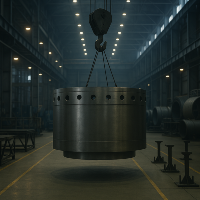
The SMR Fund begins the process of rebuilding that lost competence. It does not start with a reactor. It starts with a factory, the same way every serious national capability has always begun.
The class of reactor the Fund is designed to produce... the 77 MW commercial‑scale module... is already well‑characterized in industry analyses. A full‑scale, robotics‑integrated factory capable of manufacturing these modules is estimated at $1.5 to $3 billion, depending on automation level and throughput. A first‑generation facility is designed to produce at least four modules per year, with output rising to 10–20 modules annually as automation, tooling, and supply chains mature. That is a large number for a single utility. It is a manageable number for a national capability. And it is a trivial number compared to the tens of billions the federal government wastes annually through structural drift, duplication, and procurement inefficiency.
Redirecting even $5–10 billion per year...a fraction of what is currently lost to entropy...is enough to finance multiple factories, stabilize supply chains, and restore the industrial spine required to build reactors at scale. Once those factories exist, the economics shift dramatically. A single facility producing four modules per year becomes a regional anchor. Two factories producing eight to forty modules annually become a national capability. Three or four become a continental backbone.
This is the return of American competence: not a slogan, not nostalgia, but the deliberate rebuilding of the manufacturing base that once made national projects possible. The SMR Fund provides the financial architecture. The factories provide the capability. Together, they restore something the country has lacked for decades , the ability to build the backbone of its own future.
II. The Manufacturing Gap: Why Nuclear Became Impossible to Build
For forty years, nuclear energy has carried a reputation for being slow, expensive, and unpredictable. But the problem was never the physics. It was the manufacturing gap, the absence of a stable industrial base capable of producing reactors the way America once produced ships, turbines, and aircraft.
When the country stopped building reactors in the 1980s, the supply chain dissolved. Skilled welders, machinists, and inspectors retired without replacement. Component manufacturers closed or shifted to other industries. Regulatory expertise thinned. By the time the nation tried to restart nuclear construction in the 2000s, the industrial muscle memory was gone.
The consequences were structural:
- Every reactor became a bespoke project.
No two sites used the same components, tooling, or sequencing. - FOAK costs never collapsed.
Because every project was FOAK — first‑of‑a‑kind in design, workforce, and supply chain. - Timelines stretched from years to decades.
Not because nuclear is inherently slow, but because bespoke construction is. - Utilities faced catastrophic capital exposure.
A single project could threaten the balance sheet of an entire regional utility. - Regulators had no standardization to rely on.
Every review became a reinvention of the wheel.
The numbers tell the story clearly. A conventional gigawatt‑scale nuclear plant requires 8–10 million labor hours, thousands of unique components, and a construction timeline that can stretch past 10 years. Even when the engineering is sound, the industrial environment is not. No modern nation can build at scale under those conditions.
Small modular reactors were meant to solve this problem, but without factories, they cannot. A 77 MW module built as a one‑off construction project inherits all the liabilities of the old system: custom work, site‑specific delays, and unpredictable cost curves. The promise of SMRs only becomes real when the modules are manufactured, not constructed.
This is the gap the SMR Fund is designed to close.
Not by subsidizing projects, but by rebuilding the industrial base that makes projects possible.
A factory capable of producing four 77 MW modules per year is not a luxury, it is the minimum viable capability for a nation that wants nuclear to be normal again. And as throughput rises to 10–20 modules annually, the FOAK penalty collapses, supply chains stabilize, and the cost curve finally bends downward.
Nuclear did not fail because it was nuclear.
It failed because America stopped manufacturing.
The SMR Fund restores the missing capability, the manufacturing spine without which no energy transition, no grid stabilization, and no industrial revival is possible.
III. Factory‑Built Nuclear: The Only Path to Scale
The promise of small modular reactors has never been about size. It has always been about repeatability. A reactor that can be manufactured the same way every time...with the same components, the same tooling, the same sequencing, and the same quality controls...behaves like every other piece of serious industrial equipment America has ever relied on.
This is the difference between a construction project and a product.
A construction project is unpredictable.
A product is stable.
A construction project absorbs risk.
A product distributes it.
A construction project is a one‑off.
A product is a capability.
The 77 MW SMR sits at the center of this transformation. It is large enough to anchor a regional grid, small enough to be manufactured, and modular enough to scale. But the key is not the reactor itself, it is the factory that produces it.
A first‑generation SMR manufacturing facility is designed to produce at least four 77 MW modules per year. That baseline alone represents more nuclear capacity than the United States has added in most years since the 1990s. And as automation, robotics integration, and supply chains mature, throughput rises to 10–20 modules annually...the point at which nuclear becomes a normal part of American infrastructure again.
This is how FOAK costs collapse.
This is how timelines stabilize.
This is how capability compounds.
Manufacturing replaces improvisation with discipline.
It replaces bespoke construction with standardized production.
It replaces decade‑long timelines with predictable annual output.
The numbers make the case clearly. A single factory producing four modules per year adds 308 MW of new, zero‑carbon baseload annually, the equivalent of a small coal plant every year, from one facility. At ten modules per year, that becomes 770 MW. At twenty modules, 1.54 GW, a new gigawatt‑scale plant every twelve months, delivered as standardized components instead of decade‑long construction sites.
This is not theoretical.
It is the same manufacturing curve that defined American shipyards, turbine plants, and aerospace clusters for half a century. Once the tooling exists, once the workforce stabilizes, once the supply chain is locked in, the cost curve bends downward and the capability curve bends upward.
Factory‑built nuclear is not an innovation.
It is a return to the American method:
build the capability, then let the capability build the country.
IV. The SMR Fund’s Role: Financing the Factories, Not the Projects
The United States has spent decades trying to revive nuclear energy by subsidizing individual projects. It has never worked. A single reactor site carries too much risk, too much bespoke engineering, and too much exposure for any utility to absorb. The SMR Fund reverses the logic. It does not finance projects. It finances factories, the only place where nuclear becomes repeatable, affordable, and scalable.
A first‑generation SMR manufacturing facility capable of producing four 77 MW modules per year costs between $1.5 and $3 billion, depending on automation level and supply‑chain integration. That is a large number for a utility. It is a manageable number for a national capability. And it is a trivial number compared to the $150–200 billion the federal government loses annually to structural drift, procurement inefficiency, and programmatic entropy.
The Fund redirects a small, stable portion of that waste — $5–10 billion per year — into a mission‑locked capability. Not new taxes. Not new borrowing. Just a disciplined reallocation of resources that are already being spent, but producing nothing.
With that level of annual capitalization, the Fund can:
- Finance one to three factories per year, depending on scale
- Stabilize the supply chain for pressure vessels, forgings, and advanced alloys
- Anchor workforce pipelines in welding, machining, robotics, and inspection
- Standardize tooling and QA systems across all factories
- Absorb FOAK risk so utilities never face catastrophic exposure again
Once the factories exist, the economics shift from speculative to structural.
A single facility producing four modules per year adds 308 MW of new baseload annually. Two factories add 616 MW. Three add 924 MW. And as throughput rises to 10–20 modules annually, the numbers compound:
- 770 MW per factory at 10 modules
- 1.54 GW per factory at 20 modules
At that point, the Fund is no longer a financing mechanism. It is a national capability, a manufacturing spine that produces the energy backbone the country has lacked for half a century.
Utilities do not buy reactors outright. They lease them over time, the same way airlines lease aircraft. Those lease payments flow back into the Fund, making it self‑sustaining. The Fund becomes a permanent institution: a place where federal drift is converted into national strength, year after year, generation after generation.
This is the architecture that makes nuclear normal again.
Not a subsidy.
Not a stimulus.
A capability.
V. Deployment Sequencing: How the Backbone Grows
Once the factories exist, the question shifts from whether America can build nuclear to where the new backbone begins. Deployment is not a scattershot process. It follows a sequence: factories → modules → sites → stability — that compounds over time and spreads capability across the country.
The first wave of deployment is simple: anchor the grid. A single factory producing four 77 MW modules per year adds 308 MW of new baseload annually. That is enough to stabilize a regional utility, replace aging thermal units, or secure an industrial corridor that has been operating on the edge of reliability for decades. Two factories producing eight modules per year add 616 MW — the equivalent of a small coal plant every twelve months, delivered as standardized components instead of decade‑long construction sites.
The second wave expands outward. As throughput rises to 10–20 modules annually, the factories begin to supply not just regional anchors but entire states. A mature facility producing 770 MW per year can support manufacturing clusters, agricultural baseload, water systems, and data‑center corridors without straining the grid. At 1.54 GW per year, a single factory becomes a continental asset, a quiet engine of stability that delivers a new gigawatt‑scale plant every twelve months.
Deployment sequencing also stabilizes the workforce. Instead of assembling a temporary labor force at a remote site, the country builds permanent industrial hubs where welders, machinists, inspectors, and robotics technicians work year‑round. These hubs become the anchor employers for entire regions, the way shipyards and turbine plants once were. The workforce no longer migrates from project to project. It grows in place, gaining experience, precision, and institutional memory.
Regulation becomes predictable as well. When every module is identical, every review becomes faster. Inspectors evaluate the same welds, the same components, the same QA documentation. The learning curve flattens. The process accelerates. The cost of oversight falls without compromising safety. Standardization is not a shortcut. It is the foundation of reliability.
The sequencing continues outward. Once the grid anchors are in place, the modules begin to flow into rural towns, industrial parks, and agricultural regions that have been left behind by the volatility of the modern grid. A four‑module cluster...308 MW...can power a small city, a manufacturing district, or a regional water system. A single module can stabilize a rural hospital, a food‑processing plant, or a municipal utility that has been operating on thin margins for decades.
This is how the backbone grows: not through grand gestures or sweeping national plans, but through the quiet, disciplined accumulation of capability. Factories produce modules. Modules stabilize regions. Regions anchor the grid. And the grid becomes the foundation for a country that can once again build its own future.
Deployment is not the end of the process. It is the beginning of compounding stability, the moment when manufacturing turns into energy, and energy turns into national strength.
VI. Capability Is the New Stability
A country that cannot build its own backbone cannot govern its own future. For decades, America has tried to stabilize itself through policy, messaging, and ideology, while the underlying capability that once made the nation resilient quietly eroded. The result has been predictable: volatility in the grid, fragility in the economy, and a political culture that mistakes noise for strength.
The SMR Fund reverses that trajectory. It does not promise transformation through rhetoric. It delivers stability through capability, the kind that compounds year after year, factory after factory, module after module.
A single facility producing four 77 MW modules per year is not a symbol. It is a structural fact: 308 MW of new, zero‑carbon baseload added annually, with no fuel volatility, no emissions, and no dependence on foreign supply chains. At 10–20 modules per year, the numbers become continental. A mature factory producing 770 MW to 1.54 GW annually is not a project. It is a backbone, a quiet, disciplined engine of national stability.
This is how a serious country behaves.
It builds the capabilities that make everything else possible.
Energy is not just a sector. It is the foundation of every household, every industry, every farm, every city, every institution. When the foundation is unstable, the nation becomes unstable. When the foundation is strong, the nation becomes strong. The SMR Fund restores that foundation by rebuilding the manufacturing base that once defined American competence.
The path forward is not ideological. It is architectural.
It begins with factories.
It continues with modules.
It ends with a country that can once again build its own future.
Essay 3 will show what that future looks like...not in abstractions, but in the lived reality of households, industries, and rural towns that finally have the stability they have been denied for half a century. The manufacturing spine becomes the energy backbone. The energy backbone becomes the economic backbone. And the economic backbone becomes the national backbone.
Capability is the new stability.
And stability is how a nation renews itself.