The SMR Fund: Rebuilding America’s Energy Backbone
America doesn’t need a new ideology. It needs a backbone, a stable, domestic energy foundation built from capability, not rhetoric. The SMR Fund is the architecture that turns federal drift into national strength.

A National Capability Built From Waste
I. The Missing Foundation
America’s instability is not primarily ideological. It is structural. For more than a generation, the country has been trying to solve political, cultural, and economic problems that all trace back to a single missing capability: a stable, affordable, domestic energy foundation.
When energy is unstable, everything built on top of it becomes unstable as well. Prices swing. Supply chains fracture. Manufacturing retreats. Rural communities hollow out. Families lose predictability. Budgets strain. Inflation becomes a permanent feature of national life. Even the federal government loses its ability to plan beyond the next fiscal cycle. A nation without a reliable energy backbone becomes a nation trapped in reaction, improvisation, and drift.
This is the quiet truth beneath the noise of the moment: America is not suffering from too much conflict, but from too little capability. We have been trying to govern a twenty‑first‑century society on top of a twentieth‑century grid, with nineteenth‑century fragility built into its bones. No amount of rhetoric can compensate for a missing foundation.
This essay lays out the architecture for rebuilding that foundation. Not through mandates, not through nationalization, and not through new taxes or new borrowing...but through a permanent, mission‑locked capability built from money the federal government already wastes. A capability that restores stability to households, industry, agriculture, and the national budget. A capability that endures across administrations and political cycles. A capability that gives the country back its ability to plan, build, and steward.
America does not need a new ideology.
It needs a new backbone.
This is the blueprint for building it.
II. The SMR Fund: Turning Federal Waste Into National Strength
The federal government wastes tens of billions of dollars every year. Not through malice, and not through corruption, but through the slow drift that accumulates in any large institution over time. Empty leases continue to be paid. Redundant programs remain on the books. Procurement processes lock in outdated contracts. Agencies maintain property they no longer use. None of this is scandalous. It is simply the natural entropy of a system that has grown faster than it has reformed.
What matters is not the waste itself, but what it represents: a reservoir of dormant national capability.
The SMR Fund begins with a simple premise: instead of allowing this structural waste to dissipate into nothing, redirect a portion of it into a protected, mission‑locked trust dedicated solely to building the factories that will manufacture America’s next generation of small modular reactors. No new taxes. No new borrowing. No increase to the deficit. Just a reallocation of money the federal government is already losing.
This is not a stimulus program. It is not a grant program. It is not a subsidy. It is a capability engine.
The Fund does not pay for individual reactors. It pays for the industrial base that produces them. Factories, not projects. Tooling, not one‑offs. A national manufacturing spine that can produce modules year after year, decade after decade, until the United States once again possesses a stable, affordable, domestic energy foundation.
Once the factories exist, the reactors follow. Once the reactors exist, stability follows. And once stability returns, the country regains the ability to plan, build, and steward.
The SMR Fund is not a new idea. It is the rediscovery of an old American instinct: take what is being wasted and turn it into strength.
III. Why This Matters to Congress
Congress rarely receives proposals that solve multiple national problems at once. Most ideas arrive as narrow fixes, partisan demands, or short‑term programs that cannot survive a change in administration. The SMR Fund is different. It addresses the country’s deepest structural weaknesses...energy instability, inflation, manufacturing decline, rural collapse, and grid fragility...without raising taxes, increasing the deficit, or expanding federal bureaucracy.
It is a blueprint, not a slogan.
For lawmakers, the appeal is straightforward. The Fund converts existing federal waste into a permanent national capability. It strengthens every region of the country. It stabilizes household budgets, industrial costs, and agricultural inputs. It gives utilities a path to build new generation without taking on catastrophic financial risk. And it does all of this without forcing Congress to choose between constituencies or ideological camps.
This is the kind of architecture that attracts bipartisan interest because it is not framed as a political victory. It is framed as stewardship, the quiet work of building something that will outlast every current debate.
If taken seriously, this is the sort of proposal that leads to hearings, testimony, and legislative drafting. Not because it is loud, but because it is coherent. Not because it flatters anyone, but because it gives Congress something it rarely receives: a fiscally responsible, non‑partisan, capability‑building plan that strengthens the entire nation.
The SMR Fund matters to Congress because it gives the country back its ability to plan.
IV. Governance: A Capability That Must Outlast Administrations
A national capability cannot survive on a four‑year clock. Nuclear energy, manufacturing, and grid stability all operate on timelines measured in decades, not election cycles. If the SMR Fund were placed under the authority of an elected official or a political appointee who changes with each administration, the mission would collapse under turnover, ideological swings, and administrative resets. The country has already lived through too many examples of long‑term projects derailed by short‑term politics.
The SMR Fund must be governed like a permanent institution, not a program.
The correct model is the family of apolitical, mission‑locked bodies that have quietly anchored American stability for generations: the Federal Reserve, the TVA, the FDIC, the National Science Foundation. These institutions are not immune to oversight, they are accountable to Congress, but they are insulated from the day‑to‑day turbulence of partisan life. Their leaders serve long, staggered terms. They cannot be replaced en masse. Their missions cannot be rewritten by executive order. Their continuity is the source of their strength.
The SMR Fund requires the same structure.
A protected board, confirmed by the Senate, with long terms and removal only for cause. A director whose tenure extends beyond any single administration. A statutory mandate that cannot be repurposed without new legislation. A revenue stream that cannot be raided for unrelated spending. A firewall between the Fund and the political incentives of the moment.
Congress authorizes the mission.
The board stewards the mission.
The Fund executes the mission.
This is how you build a capability that endures. Not a program that expires. Not a pilot that fades. A backbone...stable, apolitical, and permanent...capable of carrying the country through the next century.
V. The Manufacturing‑First Strategy
America cannot rebuild its energy foundation by scattering one‑off projects across the map. That approach has failed for forty years. Every reactor becomes a bespoke construction site, every site becomes a FOAK experiment, and every experiment becomes a political liability. Costs rise. Timelines slip. Public confidence erodes. The country ends up with a handful of isolated projects instead of a national capability.
The SMR Fund reverses this dynamic by restoring the principle that built the American century: factories first, projects second.
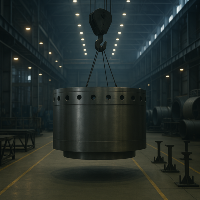
The Fund does not begin by pouring concrete at reactor sites. It begins by financing the factories that will manufacture the modules. Tooling, robotics, supply chains, standardized components...the industrial base that makes nuclear repeatable, affordable, and fast. Once the factories exist, the reactors become products, not prototypes. Modules roll off assembly lines with the same predictability that defined American shipyards, aircraft plants, and industrial clusters in the mid‑twentieth century.
This is how FOAK costs collapse.
This is how timelines stabilize.
This is how capability compounds.
A single factory can produce 10 to 20 modules per year. Two factories can supply multiple regions. Three or four can anchor a continental grid. Each factory becomes a long‑term employer, a training hub, a robotics center, and a stabilizing force in its region. And because the Fund finances the factories upfront, utilities are not forced to take on catastrophic capital risk. They lease the reactors over time, paying for stability the same way they pay for transmission or generation today.
Manufacturing first is not a slogan. It is the only path to a nuclear backbone that scales without chaos. It is the rediscovery of the American method: build the capability, then let the capability build the country.
VI. Utilities Pay Over Time, Not Upfront
The greatest barrier to new nuclear construction is not technology. It is capital. Utilities cannot take on multi‑billion‑dollar risks with twenty‑year timelines, uncertain regulatory environments, and the possibility of political reversal. Even when the engineering is sound, the financial structure is not. The result is paralysis: everyone agrees nuclear is necessary, but no one can afford to be the first mover.
The SMR Fund removes this barrier by separating construction risk from operational responsibility.
The Fund finances the factories and the modules. Utilities do not buy reactors; they lease them over time, the same way they pay for transmission infrastructure or long‑term power purchase agreements. Instead of a catastrophic upfront cost, they face a predictable, multi‑decade operating expense. This transforms nuclear from a financial gamble into a stable, budgetable asset.
This is not nationalization.
It is stewardship.
Utilities retain ownership of their sites, control their operations, and integrate the reactors into their regional grids. The federal role is limited to financing the industrial base and ensuring the reactors are manufactured to a consistent standard. The Fund absorbs the risk that no single utility can bear, while utilities provide the local expertise and operational continuity that no federal entity can replicate.
The result is a partnership that aligns incentives across every level of the system:
- The Fund builds the capability.
- Factories produce the modules.
- Utilities operate the reactors.
- Households receive stable bills.
- The nation regains its backbone.
By shifting nuclear from a capital expense to an operating expense, the SMR Fund makes the impossible suddenly practical. It gives utilities the confidence to plan, regulators the confidence to approve, and communities the confidence to support. It turns nuclear from a rare event into a normal part of American infrastructure.
This is how a country builds again.
VII. The Long Arc: A Capability That Grows Every Year
A nation does not regain stability through one‑time spending or temporary programs. It regains stability through capabilities that strengthen themselves over time. The SMR Fund is designed with this principle at its core. Once the factories are built and the first wave of reactors enters service, the Fund begins to refill automatically through long‑term lease payments from utilities. What began as a redirection of federal waste becomes a self‑sustaining engine.
This is the quiet power of the architecture: the Fund compounds.
Every reactor placed into service generates a predictable revenue stream for decades. That revenue flows back into the Fund, financing additional factories, additional modules, and additional sites. The capability grows without requiring new appropriations, new taxes, or new political battles. Waste becomes stability. Stability becomes surplus. Surplus becomes expansion.
Over time, the Fund does more than build new reactors. It modernizes the existing nuclear fleet, extending the life of plants that anchor regional grids and provide some of the most reliable power in the country. It supports component standardization, workforce training, and robotics integration. It strengthens supply chains that have been fragile for a generation. It becomes the institutional memory the nation has lacked, a place where expertise accumulates instead of dissipating with each political cycle.
This is how a backbone is built: not through a burst of activity, but through a capability that grows stronger every year. A capability that outlasts administrations, transcends political moods, and gives the country something it has not had in decades: the ability to plan beyond the next crisis.
The SMR Fund is not a program.
It is a compounding national asset.
VIII. Closing: The Architecture of Renewal
A nation cannot argue its way out of structural weakness. It cannot vote its way out of volatility. It cannot regulate its way out of fragility. The only path forward is the one America has taken before: rebuild the foundation, and let the foundation restore the country.
The SMR Fund is not a theory. It is not a partisan project. It is not a temporary program designed to satisfy the urgency of the moment. It is a permanent capability built from money the federal government already wastes, a quiet correction to decades of drift. A way to turn entropy into strength, instability into predictability, and national anxiety into national confidence.
If the country chooses to build this capability, the effects will be felt everywhere: in household budgets that stop swinging with global fuel markets, in factories that return to American soil, in rural towns that regain purpose, in utilities that can plan beyond the next rate case, and in a federal government that can finally breathe again. Stability is not an abstraction. It is the condition that makes stewardship possible.
America does not need a revolution.
It needs a backbone.
A foundation strong enough to carry the weight of a nation that still wants to build, still wants to work, and still wants to hand something durable to the next generation. The SMR Fund is that foundation...a simple, structural, fiscally responsible architecture that gives the country back its ability to plan.
This is how renewal begins: quietly, steadily, and with the rediscovery of a truth we once knew by heart.
Capability is destiny.