The Return of Apprenticeship
Every renewal begins with transmission, the passing down of skill, judgment, and responsibility through apprenticeship. Once the backbone of formation, apprenticeship has collapsed, leaving a generation eager to learn and a generation eager to teach with no structure connecting them.
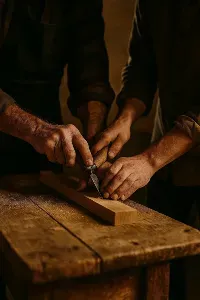
Every renewal begins with transmission.
Every renewal begins with transmission. The passing down of skill, judgment, and responsibility from one generation to the next. For most of human history, this transmission happened through apprenticeship. It was not a program. It was a relationship. It was not curriculum. It was formation.
Today, apprenticeship is treated as an artifact of the past.
But it is the most future‑oriented system we ever created.
If The Crisis section showed what breaks when apprenticeship disappears, The Workshop begins the work of rebuilding it.
I. Apprenticeship as Formation
Apprenticeship was never just about learning a trade.
It was about becoming someone capable of carrying weight.
A good apprenticeship formed:
- competence
- character
- confidence
- resilience
- humility
- belonging
It taught a young man how to work, how to endure, how to solve problems, and how to contribute to something larger than themselves.
This is not nostalgia.
It is anthropology.
Human beings are shaped through imitation, repetition, and correction, not abstraction.
II. Why Apprenticeship Collapsed
The disappearance of apprenticeship was not caused by a single decision.
It was the result of many small shifts:
- schools removed shop classes
- trades were framed as “fallback options”
- college became the default
- liability fears discouraged mentorship
- communities lost density
- older workers retired without replacements
The result is a generation of young men who want to learn and a generation of older craftsmen who want to teach, but no structure connecting them.
This is the apprenticeship desert.
III. What Apprenticeship Actually Requires
Rebuilding apprenticeship does not require massive institutions.
It requires five simple ingredients:
1. A master
Someone who knows the craft and is willing to teach it.
2. An apprentice
A young man willing to learn through effort, repetition, and correction.
3. A craft
Something real, tangible, and worth mastering.
4. A place
A workshop, a jobsite, a garage, a bench…anywhere work is done.
5. A rhythm
Regular time together, long enough for skill to take root.
Everything else is optional.
IV. The Modern Misunderstanding
Today, we treat apprenticeship as a bureaucratic credentialing process.
But real apprenticeship is relational, not administrative.
It is built on:
- trust
- proximity
- repetition
- shared work
- mutual respect
A form filled out is not apprenticeship.
A young man standing beside a master, learning by doing…that is apprenticeship.
V. Why Apprenticeship Matters Now
We are entering an era where:
- the workforce is shrinking
- infrastructure is aging
- trades are understaffed
- communities are fragmented
- young men lack formation
- institutions lack continuity
Apprenticeship is the only system that addresses all of these at once.
It rebuilds competence, connection, and continuity simultaneously.
VI. The Foundry’s Mandate
The Foundry exists to help revive apprenticeship — not as a nostalgic gesture, but as a civilizational necessity.
We believe:
- Every community has masters who can teach.
- Every young man deserves a pathway into competence.
- Every craft is a doorway into adulthood.
- Every workshop is a place of formation.
- Every society depends on transmission.
The return of apprenticeship is not optional.
It is the hinge on which renewal turns.
This is the work ahead.
This is the work of The Workshop.