The Repairer’s Toolkit
Repairers don’t just feel responsible, they carry tools. Not only physical tools, but habits, mindsets, and rituals that equip them to restore what others discard. The Repair Manual names the toolkit required for daily, durable repair.
Repairers don’t just feel responsible. They carry tools.
Not just physical tools, though those matter.
But symbolic tools: habits, mindsets, and rituals that equip them to restore what others discard.
If The Ladder and the Lattice named the structure of vocational repair, this essay names the tools of the repairer.
I. What a Toolkit Actually Is
A toolkit is not a collection.
It is a pattern.
It is a set of resources that:
- reinforce identity
- enable action
- transmit memory
- sustain rhythm
- dignify labor
A repairer without tools is a repairer who burns out.
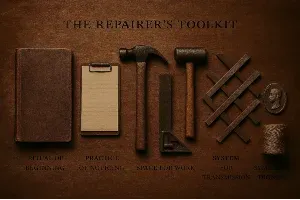
II. The Seven Tools Every Repairer Needs
1. A Ritual of Beginning
Repairers don’t wait for motivation.
They begin with rhythm, a morning ritual, a workspace reset, a prayer, a checklist.
This is the ignition.
2. A Practice of Noticing
Repair begins with attention.
The crack in the wall. The silence in the room. The drift in the soul.
Repairers train their eyes to see what others ignore.
3. A Structure for Skill
Repairers build competence.
They don’t chase perfection, they pursue mastery.
They keep a notebook, a mentor, a rhythm of learning.
4. A Space for Work
Repair needs a place.
A bench. A table. A corner. A shed.
Repairers claim space, not for ego, but for stewardship.
5. A System for Memory
Repairers preserve what came before.
They keep records, journals, archives, stories.
They know that memory is part of maintenance.
6. A Network of Transmission
Repairers don’t work alone.
They mentor. They ask. They share.
They build lattices of skill and trust.
7. A Symbol of Dignity
Repairers carry something that reminds them:
This work matters.
A tool passed down. A phrase. A badge. A worn book.
Not for show, for grounding.
III. Why This Matters Now
We are entering an era of:
- vocational drift
- cultural forgetfulness
- institutional churn
- male dislocation
Repairers will be essential.
But they must be equipped.
The toolkit is not decorative.
It is survival.
IV. The Foundry’s Mandate
The Foundry exists to equip repairers, not with slogans, but with tools.
We believe:
- Repair is not reactive. It is rhythmic.
- Tools are not optional. They are formative.
- Dignity is built through daily structure.
- Transmission requires scaffolding.
- The toolkit is not theoretical. It is practical, repeatable, and within reach.
This is the work ahead.
This is the work of The Repair Manual.