The Ladder and the Lattice
For decades, young people were told to climb the ladder, a brittle model built on linear progress and institutional stability that no longer exists. The lattice offers a better path: adaptive, interwoven, resilient. The Repair Manual names this new architecture of vocational formation.
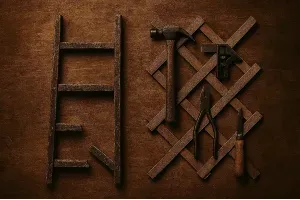
For decades, we told young people to climb the ladder.
For decades, we told young people to climb the ladder.
Pick a path.
Ascend.
Succeed.
But the ladder is broken.
In its place, we must build the lattice. A structure of horizontal and vertical movement, interwoven skills, and resilient formation.
If The Four Quadrants named the domains of responsibility, this essay names the architecture of vocational repair.
I. The Myth of the Ladder
The ladder promised:
- linear progress
- predictable promotions
- institutional loyalty
- clear credentials
- stable identity
But today:
- institutions churn
- credentials inflate
- promotions stall
- industries collapse
- identity fragments
The ladder is no longer reliable.
It is brittle.
II. What the Lattice Offers
The lattice is not a fallback.
It is a better model.
It offers:
- horizontal skill-building
- vertical responsibility
- interwoven mentorship
- adaptive movement
- vocational resilience
The lattice is not chaotic.
It is structured, but flexible.
III. How the Lattice Works
In a lattice model, men grow by:
- acquiring adjacent skills
- serving across domains
- mentoring and being mentored
- adapting to new roles
- building legacy through contribution, not title
A man may move:
- from trades to teaching
- from service to strategy
- from execution to mentorship
- from one institution to another, without losing identity
The lattice honors formation.
Not just advancement.
IV. Why This Matters Now
We are entering an era of:
- economic volatility
- institutional churn
- skill fragmentation
- male vocational drift
Young men are not failing because they lack ambition.
They are failing because the ladder collapsed and no one showed them the lattice.
V. The Foundry’s Mandate
The Foundry exists to help rebuild vocational formation, not through slogans, but through structure.
We believe:
- Work is not just economic. It is formative.
- Men need scaffolding, not slogans.
- The lattice is not chaotic. It is resilient.
- Mentorship must be interwoven, not optional.
- Vocational repair is not theoretical. It is practical, repeatable, and within reach.
This is the work ahead.
This is the work of The Repair Manual.