The Gendered Inheritance of Infrastructure
A clear look at why the heaviest and most dangerous work in society was overwhelmingly male, and how misremembering that history obscures the real problem: the disappearance of the builder and maintainer lineage that keeps a nation functioning.
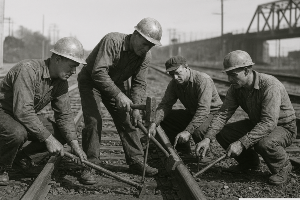
A historical examination of how the builder class formed, and why its lineage is now fading.
I. Opening: The Story We Tell About Who Built the World
Every society inherits a story about who built the physical world around it. In our own time, that story is often retold through the lens of present‑day ideology, with some insisting that the overwhelmingly male character of the builder and maintainer class must have been the result of exclusion alone. But the historical record is far more complex than that.
For as long as human beings have raised structures, carved roads, laid pipe, strung wire, and repaired the systems that keep a nation alive, the work has been carried out primarily by men...not as a moral judgment, but as a durable pattern shaped by culture, economics, physical demands, and self‑selection.
This essay steps back from the noise to examine that pattern clearly, and to understand why remembering it accurately matters for the lineage we have now allowed to fade.
II. The Historical Reality: Labor Has Always Been Gendered
Across civilizations, the work of building and maintaining the physical world has followed a remarkably consistent pattern. Long before modern politics, long before industrialization, and long before contemporary debates about representation, societies organized labor along lines that reflected the demands of survival. The heaviest, most dangerous, and most physically taxing work...felling timber, quarrying stone, forging metal, raising structures, digging canals, laying track, repairing ships, mining ore...was carried out almost entirely by men.
This was not a uniquely American arrangement, nor a product of any single culture’s norms. It appears in ancient Mesopotamia and imperial China, in medieval Europe and pre‑colonial Africa, in the early Americas and the industrial age alike. The gendered division of labor was not an ideology; it was a durable pattern shaped by the realities of pre‑modern life, where strength, endurance, and risk tolerance were not abstractions but daily requirements.
To understand the lineage of builders and maintainers, we must begin with this simple historical truth: the physical world was constructed within a gendered framework that long predates the narratives we project onto it today.
III. Why Men Dominated the Builder/Maintainer Roles
The gendered pattern of infrastructure work did not emerge from a single cause. It was the product of overlapping forces...physical, economic, cultural, and voluntary...that shaped how societies organized labor long before modern debates about representation. Understanding these forces is essential for understanding the lineage we have now allowed to disappear.
1. Physical Demands
For most of human history, infrastructure work required sustained physical strength, endurance, and tolerance for risk. Before mechanization, raising a structure meant lifting timber, hauling stone, climbing heights, and working in extreme weather. Digging canals, laying track, forging metal, and repairing ships were not symbolic tasks; they were feats of bodily exertion. In every civilization, the people who performed this work were overwhelmingly men, not because of ideology, but because the physical demands of survival made the division of labor unmistakably clear.
2. Economic Structure
The economic logic of pre‑modern life reinforced this pattern. Families depended on a division of labor that maximized survival: men took on the dangerous, high‑injury work that could not be interrupted, while women took on the essential domestic, agricultural, and community roles that sustained daily life. This was not a hierarchy of value but a distribution of necessity. The risks borne by men in the trades were balanced by the responsibilities borne by women in the home and community. Both were indispensable; both were demanding; both were structured by the realities of survival rather than the politics of representation.
3. Cultural Norms
Over time, these economic and physical patterns hardened into cultural expectations. Trades became male social worlds with their own rituals, hierarchies, and identities. Apprenticeship systems were built around father‑to‑son transmission, reinforcing the lineage of builders as a distinctly male inheritance. This was not a conspiracy or a coordinated exclusion; it was the natural outcome of how communities reproduced knowledge in an era when skill was passed down through families, not institutions.
4. Self‑Selection
Even in periods with fewer formal barriers, women rarely entered the heavy trades. The pattern persisted across centuries and continues today despite open access, scholarships, recruitment programs, and legal protections. The gender distribution in fields like electrical work, ironwork, mining, and construction has shifted only marginally, suggesting that the historical pattern was driven by more than external constraints. Self‑selection...shaped by culture, interest, risk tolerance, and the nature of the work...remains a powerful force.
5. Injury and Fatality Rates
The trades that built and maintained the physical world have always carried the highest injury and fatality burdens. This is not a modern discovery; it is a stable pattern that appears in every dataset we have. In the United States today, the occupations with the highest death rates...logging, commercial fishing, roofing, iron and steel work, electrical line installation, mining, and heavy construction...are between 90% and 99% male. These fields routinely record fatality rates many times higher than the national average. Logging and commercial fishing, for example, often exceed 100 deaths per 100,000 workers, while the national average across all occupations typically sits below 4 per 100,000. Even within construction, one of the broadest and most mechanized sectors, men account for over 97% of workplace deaths.
Injury rates follow the same pattern. Roofing, ironwork, electrical line work, and heavy equipment operation consistently rank among the most injury‑prone jobs in the country, with non‑fatal injury rates several times higher than those in healthcare, education, retail, or administrative work...fields where women are more heavily represented. These risks shaped not only the economic logic of earlier eras but also the cultural expectations and self‑selection patterns that guided who entered the trades. When the work of building and maintaining a nation carried a real chance of maiming or death, it was overwhelmingly men who stepped into those roles.
The persistence of this pattern into the modern era...despite open access, legal protections, and active recruitment efforts...suggests that the historical gender distribution in high‑risk trades was driven by more than exclusion alone. The danger inherent in the work has always been a defining feature of the builder/maintainer lineage, and it remains one of the clearest explanations for why that lineage formed as it did.
IV. What Modern Narratives Get Wrong
In the present, the historical pattern of gendered labor is often retold through a simplified moral framework. Some argue that the absence of women in the heavy trades must have been the result of exclusion alone, as though the past were a blank canvas onto which modern ideals can be projected. But this interpretation flattens a far more complex reality.
It treats history as a morality play rather than a record of how societies actually organized themselves under the pressures of survival, risk, and physical necessity. By reducing a multi‑layered pattern...shaped by biology, culture, economics, apprenticeship, and self‑selection...into a single explanation, these narratives obscure more than they reveal. They replace the lived logic of earlier eras with the assumptions of our own, and in doing so, they make it harder to understand the lineage that built and maintained the physical world. Misremembering the past does not correct an injustice; it simply blinds us to the forces that shaped the world we inherited.
V. Why This Matters for Lineage & Infrastructure
The question of who built the physical world is not an abstract historical curiosity. It is central to understanding the crisis we face today. The lineage of builders and maintainers...the people who laid the pipes, wired the grids, raised the structures, repaired the systems, and kept the machinery of daily life running...has thinned to a degree that would have been unthinkable a century ago. If we misremember who those people were, or why they entered the trades in the first place, we misdiagnose the forces that have led to their disappearance.
The decline of the maintainer class is not the result of a corrected injustice or a long‑overdue rebalancing. It is the result of cultural drift, demographic change, the collapse of apprenticeship, and the devaluation of skilled labor. When we rewrite the past to fit modern narratives, we lose sight of the real causes of today’s fragility. And without an accurate understanding of the lineage we inherited, we cannot hope to rebuild the one we need.
VI. The Real Loss: A Vanishing Lineage, Not a Correctable Injustice
The disappearance of the builder and maintainer class is not a story about injustice finally being corrected. It is a story about a lineage quietly collapsing. For generations, the knowledge that kept a nation functioning...how to wire a grid, weld a beam, repair a water main, climb a transmission tower, or bring a failing system back online at three in the morning...was passed from one cohort of men to the next through apprenticeship, mentorship, and lived experience. That chain has thinned to the point of fragility. The issue before us is not whether the past was perfectly balanced, but whether the present is prepared for the consequences of losing the people who once held these skills in abundance.
When we reinterpret the historical gender distribution of the trades as a moral failure rather than a structural reality, we obscure the true nature of today’s crisis. The problem is not that the past was insufficiently representative; it is that the present has allowed an entire class of essential workers to fade without replacement. The systems they maintained...electrical grids, water networks, transportation corridors, industrial plants...do not care about our narratives. They require hands, knowledge, and a lineage of competence. And that lineage is vanishing.
The real loss, then, is not symbolic. It is material. It is the loss of the people who knew how to keep the physical world standing. No amount of retrospective reinterpretation can substitute for the absence of those who once carried that responsibility.
VII. Closing: A Call for Honest Memory
A society cannot repair what it refuses to remember clearly. The gendered inheritance of infrastructure is not a story about blame or grievance, but about accuracy. For generations, the work of building and maintaining the physical world followed patterns shaped by necessity, risk, and culture, patterns that cannot be rewritten without distorting the lineage we have already allowed to fade.
If we are to confront the fragility of our present moment, we must begin with an honest account of how the world was built, who carried its burdens, and why those burdens were distributed as they were. Clarity is not nostalgia. It is the first step toward renewal. And without it, the systems we depend on will continue to age faster than our willingness to understand the people who once kept them alive.