The Gen Z Trades Boom Is Real and Still Not Enough
After decades of decline in skilled labor, Gen Z is turning back toward the trades — a hopeful generational pivot that signals hunger for mastery, meaning, and responsibility. But the deficit is too deep for one generation to repair alone.
For decades, America has been bleeding skilled labor.
The collapse of shop classes, the disappearance of apprenticeships, the prestige inflation of four‑year degrees, and the retirement cliff of Boomers and Gen X is going to create a deficit so deep that entire sectors of the country now run on borrowed time. Bridges, grids, water systems, rail, housing, all depend on a workforce that is aging out faster than it can be replaced.
This is the crisis The Foundry was built to name.
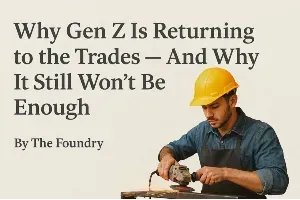
But something remarkable is happening beneath the surface. After forty years of decline, a generation is turning back toward the trades. Gen Z. The cohort raised on screens, algorithms, and the myth of the “knowledge economy”, is quietly choosing a different path.
Trade‑school enrollment among Gen Z has surged in recent years. Young men are walking away from the debt‑degree treadmill and toward welding bays, diesel shops, electrical labs, and carpentry programs. They are choosing work that is tangible, embodied, and necessary. They are choosing mastery over abstraction, contribution over credentialism, and community over placelessness.
This is not a cultural footnote. It is a generational pivot.
And yet, it is still not enough.
The Scale of the Problem
The long-term decline in skilled labor is not a matter of preference. It is a matter of math.
Even if every Gen Z male enrolled in a trade program tomorrow, the numbers would still fall short. The retirement wave is too large. The infrastructure backlog is too deep. The birth‑rate collapse has already shrunk the pipeline of future workers. The apprenticeship ladder that once carried boys into adulthood has been dismantled and rebuilding it will take more than enthusiasm.
A single generation cannot repair a four‑decade deficit.
Gen Z’s return to the trades is hopeful, but it cannot, by itself, reverse the structural damage.
Why Gen Z Is Turning Back
The motivations are deeper than economics.
Young people are searching for:
- Dignity — the sense that their work matters
- Mastery — the satisfaction of competence
- Belonging — the mentorship and camaraderie missing from digital life
- Stability — a future not dependent on algorithms or layoffs
- Reality — the grounding that comes from working with one’s hands
In an era of disembodied life, the trades offer something rare: a path back into the world.
This is not nostalgia. It is a survival instinct.
The Opportunity and the Danger
The danger is assuming the Gen Z surge solves the problem. It doesn’t.
The opportunity is recognizing what it signals:
a generation hungry for responsibility, purpose, and contribution.
But hunger alone is not a system.
If America wants a functioning skilled‑labor pipeline, it needs:
- rebuilt apprenticeship ladders
- intergenerational mentorship
- cultural respect for manual competence
- institutions that form character, not just skills
- communities that honor work as service
This is where The Foundry enters the story.
The Foundry’s Role
Trade schools can teach technique.
They cannot teach meaning.
They cannot teach:
- why work matters
- what it means to build
- how a man becomes dependable
- how communities are held together
- why mastery is a moral good
The Foundry exists to articulate the deeper architecture of renewal. The cultural, civic, and intergenerational scaffolding that makes a trades revival possible.
Gen Z is showing the first signs of return.
Our task is to ensure that return becomes a restoration.
A Spark Is Not a Revival
The Gen Z trades boom is real.
It is encouraging.
It is a sign of life.
But it is not yet a revival.
A revival requires:
- fathers and mentors
- institutions that endure
- communities that transmit skill and character
- a culture that honors builders
- a nation that remembers what it takes to maintain itself
Gen Z has taken the first step.
The Foundry exists to help build the rest.