The Foundry’s Field Guide
Repair is not a mood but a method, a five‑part rhythm of noticing, naming, equipping, acting, and transmitting. The Foundry’s Field Guide distills the habits, structures, and tools of repair into a practical framework men can use every day.
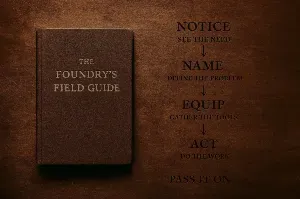
Repair is not a mood. It is a method.
Not just a mindset.
A map.
This is the field guide, the practical framework that distills the habits, quadrants, structures, tools, and mandates into a repeatable rhythm.
If The Local Mandate grounded repair in place, this essay grounds it in practice.
I. The Five-Part Framework
1. Notice
Repair begins with attention.
Train your eyes to see what others ignore, the fray, the drift, the silence, the decay.
2. Name
Repair requires clarity.
Name the domain: personal, relational, communal, vocational.
Name the damage. Name the responsibility.
3. Equip
Repair demands tools.
Gather what you need: physical, symbolic, structural.
Build your toolkit. Sharpen your skills.
4. Act
Repair is not theoretical.
Do the work.
Fix the hinge. Make the call. Mentor the boy. Show up.
5. Transmit
Repair must be passed on.
Teach. Share. Document. Invite.
Build the lattice. Strengthen the chain.
This is the rhythm.
This is the method.
II. Why a Field Guide Matters
Men drift when they lack structure.
They burn out when they lack rhythm.
They isolate when they lack transmission.
The field guide is not decorative.
It is survival.
III. The Foundry’s Mandate
The Foundry exists to equip repairers, not with slogans, but with scaffolding.
We believe:
- Repair is not reactive. It is rhythmic.
- Men need maps, not moods.
- Formation requires structure.
- Transmission requires clarity.
- The field guide is not theoretical. It is practical, repeatable, and within reach.
This is the work ahead.
This is the work of The Repair Manual.