The Erasure: How Their Work Was Rewritten or Forgotten
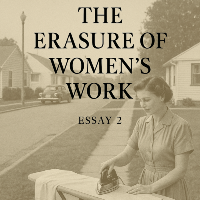
The small world collapsed. The civic labor women once performed with pride was reclassified as unpaid domestic work and then forgotten. This essay traces how the erasure happened, and why the modern world misreads what women actually did.
I. The Vanishing of a World
The small world did not disappear all at once. It faded slowly, quietly, almost imperceptibly and as it went, the memory of the women who sustained it faded even faster. A form of authority that had shaped families, neighborhoods, churches, and towns for generations slipped out of public consciousness in the span of a few decades. What had once been understood as essential civic labor was reinterpreted through modern categories as unpaid work, domestic confinement, or even oppression.
This erasure did not happen because the work was trivial. It happened because the world that recognized its value no longer exists.
From the 1950s through the 1980s, women maintained the social infrastructure of American life under the shadow of the Cold War. They stabilized families, preserved community memory, and held neighborhoods together during a period defined by existential anxiety. Their work was not peripheral to national life, it was part of the country’s psychological resilience. And they performed it with pride, not reluctance. They understood themselves as stewards of something fragile and necessary.
But modernity changed the metrics. It elevated what could be counted, credentialed, or paid, and dismissed everything else as invisible. When the Cold War ended and the small world collapsed, the meaning of women’s labor collapsed with it. What had once been recognized as civic responsibility was reclassified as “unpaid domestic work,” and therefore assumed to be oppressive.
This essay traces how that misinterpretation took hold, how a culture that prides itself on progress lost sight of the women who once governed its social world. Before we can understand the collapse that followed, we must understand the erasure that preceded it.
II. The Shift in Metrics — When Power Became Bureaucratic
The erasure of women’s work did not begin with ideology. It began with a change in how the modern world measures value.
In the mid‑20th century, especially in the decades shaped by the Cold War, women maintained the social infrastructure of American life with competence and pride. They stabilized families, coordinated community life, preserved memory, and ensured that neighborhoods functioned as coherent units. Their work was understood as civic labor, not because it was paid, but because it was necessary.
But as the century progressed, the metrics of value shifted. Modernity increasingly recognized only what could be formalized:
titles, salaries, credentials, institutional authority.
Anything that fell outside those categories was quietly downgraded.
Women’s work did not disappear, the framework for seeing it did.
The rise of bureaucratic institutions replaced community‑based authority with credentialed authority. The relational governance women practiced...the diplomacy, the coordination, the memory‑keeping, the stabilizing...could not be captured in budgets or organizational charts. It produced no paperwork, no job titles, no measurable outputs. And so, in a culture that equated value with quantification, it became invisible.
This is where the modern misinterpretation took root.
Because the work was unpaid, modern frameworks assumed it was unskilled.
Because it was uncredentialed, they assumed it was trivial.
Because it was relational, they assumed it was passive.
Because it was performed with pride, they assumed it was coerced.
The category error is profound.
Women’s labor was unpaid not because it lacked value, but because it was not a market function. It was a civic function, the maintenance of the social world that allowed the physical world to operate. But once the metrics changed, the meaning changed with them. What had been recognized as essential became reclassified as “domestic work,” and therefore dismissed as lesser or oppressive.
This shift in metrics is the foundation of the erasure.
It is how a culture that depended on women’s authority lost the ability to perceive it.
III. The Misreading of the 1950s
No decade in American life is more misunderstood than the 1950s. Modern culture remembers it through advertising images, sitcom aesthetics, and political narratives that flatten the lived experience of the people who inhabited it. The result is a caricature: the bored, passive housewife trapped in domestic confinement while men built the world outside.
But this image tells us more about the assumptions of the present than the reality of the past.
In the mid‑century small world, women were not idle. They were not sidelined. They were not waiting for liberation. They were maintaining the social infrastructure of American life during one of the most psychologically demanding eras in human history. The Cold War shaped everything: the pace of life, the structure of families, the cohesion of neighborhoods, the rituals of community. Under the shadow of nuclear threat, stability at home was not a luxury. It was a national necessity.
Women understood this.
And they took on the work with pride.
They organized the civic life of towns, preserved community memory, stabilized families, and ensured that neighborhoods functioned as coherent, resilient units. Their labor was not merely domestic; it was civic. It was part of the country’s psychological defense system...the quiet, continuous work of keeping a society steady in an age of existential anxiety.
Modern frameworks cannot see this because they interpret the past through a single metric:
Was the labor paid?
If not, the assumption follows:
It must have been oppressive.
This is a profound misreading.
Women’s work was unpaid not because it lacked value, but because it was not a market function. It was a form of governance...relational, distributed, memory‑based, and essential. The absence of wages did not signal the absence of agency. The absence of credentials did not signal the absence of authority. The absence of formal titles did not signal the absence of power.
The women who lived through the 1950s and 1960s did not describe themselves as oppressed. They described themselves as responsible: for their families, their churches, their neighborhoods, and the fragile stability of a world that could, at any moment, be thrown into chaos.
The modern caricature erases this reality.
It replaces competence with passivity.
It replaces agency with confinement.
It replaces civic labor with domestic drudgery.
To understand what was lost, we must first understand what was misread.
IV. The Collapse of Community Memory
The erasure of women’s work did not begin with ideology or activism. It began with the disappearance of the world that made their authority visible.
For generations, women carried the memory of the community — who was trustworthy, who needed help, who was drifting, who had changed, who could be relied upon in a crisis. This memory was not written down. It lived in relationships, in conversations, in the quiet continuity of people who stayed in one place long enough to know one another deeply.
When the small world began to dissolve, that memory dissolved with it.
Mobility scattered families across states and regions.
Suburbanization replaced neighborhoods with subdivisions.
Churches weakened.
PTAs hollowed out.
Extended families fragmented.
The civic life women once coordinated became thinner, more transactional, less rooted.
The relational archive that women maintained...the living record of a community’s moral and social life...had no institutional backup. It existed only in the minds of the women who kept it. When they aged, moved, or passed away, the archive vanished.
And because the work had been done with pride and competence, it left no record of struggle. There were no manifestos, no protests, no demands for recognition. Women did not narrate their labor as oppression; they narrated it as responsibility. They did not frame it as unpaid drudgery; they framed it as stewardship. They did not document it because they did not imagine a world in which it would be forgotten.
This silence became the opening through which modern misinterpretations entered.
A generation grew up without the small world’s continuity. They inherited a landscape of weakened institutions, transient neighborhoods, and thin social ties...and then looked backward through the lens of their own experience. Without the memory of what women had actually done, the past became easy to flatten. The civic labor that once held communities together was reinterpreted as mere domesticity. The authority women exercised was mistaken for passivity. The pride they took in their work was rewritten as resignation.
The collapse of community memory did not just erase the record of women’s work.
It created the conditions for the modern world to misunderstand it entirely.
V. The Rise of Academic Narratives
The collapse of community memory created a vacuum and vacuums never stay empty. Into that space stepped a new set of interpreters: academics, theorists, and commentators who attempted to explain the past using the tools of modern analysis. Their frameworks were rigorous, but they were built for a different kind of world. They could measure political power, economic output, and institutional authority. They could not measure relational governance, distributed memory, or the quiet maintenance of social cohesion.
And so the story changed.
In the absence of the small world’s living witnesses, academic narratives became the default explanation for women’s historical role. These narratives were not malicious; they were simply built on the assumptions of modernity. They treated unpaid labor as inherently exploitative, domestic work as inherently subordinate, and informal authority as inherently powerless. What could not be quantified was dismissed. What could not be credentialed was ignored. What could not be archived was assumed not to exist.
The result was a profound misclassification.
Women’s civic labor...the organizing, stabilizing, coordinating, and memory‑keeping that sustained the social infrastructure...was reinterpreted as “domestic drudgery.” Their relational authority was reframed as passivity. Their pride in their work was rewritten as resignation. Their Cold War–era sense of responsibility was recast as false consciousness.
The frameworks were elegant.
The conclusions were wrong.
Academic models privileged the visible over the invisible, the formal over the informal, the economic over the relational. They could track wages, but not trust. They could analyze institutions, but not neighborhoods. They could measure political power, but not the social authority women exercised daily in the small world.
And because these models were taught in universities, repeated in media, and embedded in public discourse, they became the dominant lens through which the past was understood. The lived reality of millions of women was overwritten by a theory that could not perceive the world they inhabited.
This is how the erasure hardened.
Not through conspiracy, but through misalignment, a mismatch between the tools used to interpret the past and the nature of the past itself.
The academic narrative did not simply forget women’s work.
It replaced it with something unrecognizable.
VI. The Cultural Incentive to Forget
The modern world did not simply overlook the work women once did. It had strong incentives to forget it.
A society built on mobility cannot acknowledge the value of rootedness.
A society built on individualism cannot acknowledge the value of relational authority.
A society built on credentialism cannot acknowledge the value of uncredentialed expertise.
And a society built on markets cannot acknowledge the value of civic labor that is not bought or sold.
As the small world collapsed, the domain women once governed disappeared. The institutions that depended on their memory weakened. The neighborhoods they stabilized became transient. The families they anchored scattered. The civic life they coordinated thinned into a set of optional activities rather than a shared responsibility.
Into that vacuum stepped feminism, not as the cause of the collapse, but as the framework that reinterpreted what women had once done.
Feminism emerged in a world where the social infrastructure had already eroded. The relational authority women once exercised was no longer visible. The civic labor they performed was no longer legible. The pride they took in their work was no longer intelligible. Without the context of the small world, the work women had done for generations could only be understood through the categories modernity had left: paid vs. unpaid, public vs. private, liberation vs. oppression.
And so the reinterpretation followed.
What had been civic labor became “unpaid domestic work.”
What had been authority became “subordination.”
What had been responsibility became “confinement.”
What had been pride became “false consciousness.”
Feminism did not replace women’s work.
It replaced the memory of women’s work.
This was not intentional. It was structural. Feminism arose in a world that no longer recognized the domain women had once governed. It filled the explanatory void left by the collapse of the small world, offering a coherent narrative where lived memory had vanished. But in doing so, it hardened the erasure. It made the past appear simpler, flatter, and more oppressive than it had been.
The cultural incentive to forget was powerful.
Remembering the truth would require acknowledging that women once held a form of authority modernity cannot measure and therefore cannot fully comprehend.
VII. The Testimony of the Last Witnesses
The erasure of women’s work is easiest to see in the stories of the women who lived through the small world and watched it disappear. They are the last witnesses to a form of civic life that no longer exists and their testimony contradicts nearly every modern assumption about the past.
These women do not describe themselves as oppressed.
They describe themselves as responsible.
They remember coordinating the life of neighborhoods, managing the emotional stability of families, sustaining churches, organizing community rituals, and holding together the fragile continuity of local life. They remember the pride they took in their work...not because it was glamorous, but because it mattered. They remember the sense of duty that came from living under the shadow of the Cold War, when stability at home felt like part of the country’s resilience. They remember the competence, the seriousness, the quiet authority.
And they remember that none of it was written down.
Their stories reveal a world where women’s labor was understood as civic stewardship, not domestic confinement. They speak of the small world as something they maintained deliberately...a structure of relationships, obligations, and shared memory that required constant attention. They speak of the work as meaningful, not because it was paid, but because it held their communities together.
But they also speak of the moment it began to unravel.
They remember when neighborhoods thinned, when families scattered, when churches weakened, when the rituals that once anchored community life became optional or disappeared entirely. They remember watching the next generation grow up without the continuity that had defined their own lives. They remember the shock of hearing their work described as “unpaid labor,” as if the absence of wages meant the absence of value.
Their testimony exposes the gap between lived experience and modern interpretation.
It shows that the collapse of the small world was not simply a change in lifestyle. It was the disappearance of a civic architecture, one that women had maintained with competence, pride, and a deep sense of responsibility. And it shows that the modern world’s reinterpretation of their work is not a correction of the past, but a misunderstanding born from the loss of context.
These women are the last link to a world that cannot be reconstructed from data, theory, or institutional records. Their memory is the archive. Their stories are the evidence. And their clarity is the key to understanding what was lost and why the modern world struggles to see it.
VIII. Closing — Naming the Loss
The erasure of women’s work was not a single event. It was the cumulative result of structural shifts that unfolded over decades: the collapse of the small world, the rise of bureaucratic metrics, the weakening of local institutions, the disappearance of community memory, and the spread of academic frameworks that could not perceive relational authority. Each change removed one more layer of visibility from the work women had done for generations.
By the time the twentieth century reached its end, the world that had once recognized women’s civic labor no longer existed. The authority they exercised had no modern equivalent. The responsibilities they carried had no institutional successor. The memory they preserved had no archive. And the pride they took in their work had no language in which to be understood.
What remained was a simplified story, one that interpreted the past through the categories of the present. Unpaid became oppressive. Domestic became subordinate. Responsibility became confinement. Pride became false consciousness. The complexity of women’s civic labor was flattened into a narrative that bore little resemblance to the world they actually inhabited.
Naming this loss is not nostalgia. It is clarity.
A society cannot understand its present if it cannot remember its past. And it cannot remember its past if it misinterprets the work that once held it together. The collapse of the small world was not just the disappearance of a way of life. It was the disappearance of a form of governance, one that women maintained with competence, seriousness, and a deep sense of responsibility, especially under the pressures of the Cold War.
To understand the rise of feminism, we must first understand the collapse of the domain women once governed. To understand the modern world’s confusion about gender, community, and responsibility, we must understand the erasure that preceded it. And to understand what might come next, we must recover the truth of what was lost.
Essay 3 begins that work.