The Cold Civil War
A cold war isn’t defined by weapons, it’s defined by temperature. And for those of us who lived through the first one, the atmosphere of today feels eerily familiar: the tension, the near-misses, the thinning middle. But this time, the small world is gone and that changes everything.
How a Generation Raised Under One Cold Conflict Recognizes the Temperature of Another.
If you’re a Boomer or a member of Generation X, you may feel something in the air that you haven’t sensed in decades...a quiet, persistent tension that echoes the atmosphere of our youth. Not the same dangers, not the same world, but the same temperature.
We grew up with a background hum that never fully went away.
Air‑raid drills. Fallout shelter signs. Adults speaking in lowered voices.
The Cuban Missile Crisis retold in documentaries and family stories.
The near‑misses of 1979, 1980, September ’83, and November ’83...moments when a radar glitch, a misread signal, or a training exercise could have changed the course of history.
Even if we didn’t understand the geopolitics, we understood the feeling.
A society under strain.
A world divided into two realities.
A sense that the wrong spark, at the wrong moment, could send everything in the wrong direction.
That atmosphere, that low, steady tension, is what feels familiar now.
Not because we’re facing nuclear brinkmanship.
Not because the threats are the same.
But because the psychology is.
Today’s conflict is internal, not international.
But the emotional architecture is eerily similar:
the spikes of fear, the near‑misses, the brinkmanship, the sense that the middle is thinning and the extremes are growing louder.
If you grew up in the Cold War, your body recognizes this moment before your mind names it. The Cold Civil War.
I. What a Cold War Actually Is
To understand why the present moment feels familiar, we have to be precise about what a cold war actually is. It is not defined by missiles, armies, or open battlefields. It is defined by psychology, structure, and temperature.
A cold war is a condition in which two opposing blocs occupy the same world but no longer share the same reality. Each side sees itself as defending something essential, and each sees the other as a threat to the nation’s future. The conflict is not fought through armies but through institutions, narratives, and symbolic battles. It is a struggle for legitimacy, identity, and meaning.
Cold wars have several defining features:
- Parallel Realities
Each side develops its own worldview, its own media ecosystem, its own heroes and villains. Facts become contested. Motives become suspect. The other side becomes incomprehensible. - Deep Distrust
Not just disagreement, but a belief that the other side is acting in bad faith. That they are dangerous, reckless, or fundamentally un-American. Trust erodes not only between factions, but between citizens and institutions. - Proxy Conflicts
The conflict rarely erupts directly. Instead, it plays out in symbolic arenas: cultural fights, political standoffs, institutional battles. These become stand-ins for the larger struggle. - Brinkmanship
Each side pushes the boundaries to test the other’s resolve. Not to start a war, but to see who will blink. The danger lies not in intention, but in miscalculation. - Near‑Misses
Cold wars are punctuated by moments when the system strains under pressure: false alarms, misread signals, sudden shocks that reveal how close things are to slipping. - A Shrinking Middle
The center becomes quieter, more exhausted, less represented. The extremes grow louder. The space for compromise narrows.
This is the architecture of a cold war.
It is not a prediction of collapse.
It is a description of a temperature, a way of naming the atmosphere a society produces when it is deeply divided but not openly at war.
And for those of us who lived through the U.S.–Soviet Cold War, that temperature is unmistakable.
II. The Shrinking Middle and the Generational Shift
For those of us who grew up in the long shadow of the U.S.–Soviet Cold War, the present moment carries another familiar feature: the sense that the middle is thinning. During our youth, the country had its divisions...Vietnam, Watergate, stagflation, the cultural upheavals of the 60s and 70s...but there was still a broad, stabilizing center. Institutions were imperfect, but they were trusted enough to hold. Families were strained, but they were still intact enough to anchor communities. Neighbors disagreed, but they still shared a common world.
That center acted as ballast.
It absorbed shocks.
It slowed escalation.
It kept the temperature from rising too quickly.
Much of that ballast came from the generations who lived through the Depression, World War II, and the early Cold War. They carried a memory of scarcity, sacrifice, and shared purpose. Even when they disagreed, they understood the cost of letting a society fracture.
As Boomers and Gen‑Xers age, that stabilizing memory is fading.
Younger generations are stepping into a world that looks nothing like the one that shaped us:
- They are more polarized.
- They are more online.
- They are less anchored to institutions.
- They are more sorted into ideological tribes.
- They have fewer shared cultural touchstones.
- They have grown up in a world where trust is scarce and outrage is abundant.
This is not a judgment. It is a description of the environment they inherited.
When the middle shrinks, the extremes grow louder.
When institutions lose trust, narratives fill the vacuum.
When people no longer share a common world, they retreat into separate ones.
This is the generational shift that makes today feel so familiar to those of us who lived through the Cold War. Not because the threats are the same, but because the psychology of division is.
A society with a shrinking middle behaves like a society under strain.
It becomes reactive.
It becomes brittle.
It becomes vulnerable to shocks.
And that is where the parallels begin to sharpen, because the cold civil war we are living through has its own equivalents to the near‑misses and brinkmanship of our youth.
III. The Domestic Equivalents: Today’s Cold Civil War “Near‑Misses”
If the Cold War taught our generation anything, it was that danger doesn’t always announce itself with explosions. Sometimes it arrives as a misread signal, a false alarm, a moment when the machinery of a divided world slips. Those were the moments that defined our youth, not the war that never came, but the near‑misses that almost did.
Today’s conflict is different in scale and stakes, but it has its own equivalents. They are not nuclear. They are not geopolitical. But they serve the same psychological and structural role: sudden shocks that reveal how strained the system has become.
These are the moments that make the present feel familiar.
A. Assassinations and Attempts. The Modern Near‑Miss
In recent years, we’ve seen a series of targeted attacks on public figures:
the killing of a conservative insurance executive, the attack on Charlie Kirk, the attempts on Donald Trump. These events are not identical, and they are not being used here as political commentary. They are being recognized for what they are structurally: internal shock events.
They function the way Cold War near‑misses did:
- they spike national anxiety
- they reveal how much anger is simmering beneath the surface
- they expose the vulnerability of public life
- they show how close the system is to misfiring
- they force the country to confront the temperature of the moment
They are not nuclear brinkmanship.
But they are the domestic equivalent of a radar blip that could have meant something far worse.
B. Major Riots. The Proxy Conflicts of a Cold Civil War
During the Cold War, the superpowers rarely fought directly.
They fought through proxies...Korea, Vietnam, Afghanistan...symbolic battlegrounds where larger forces collided.
Today’s equivalents are internal:
- riots
- mass protests
- clashes that become national symbols
- events each side interprets as proof of the other’s danger
These are not full-scale conflicts.
But they are proxy battles in a divided society, eruptions that reveal the depth of the underlying tension.
C. ICE Clashes. The Confrontation Zones
Every cold conflict has physical spaces where the tension becomes visible.
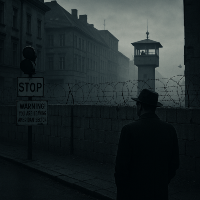
Berlin had Checkpoint Charlie.
We have ICE facilities, courthouses, and state capitols, places where two worldviews stand face-to-face.
These are not battlefields.
But they are confrontation zones, where the cold conflict briefly becomes physical.
D. Government Shutdown Battles. The Brinkmanship of a Divided Nation
Cold War brinkmanship was the art of pushing to the edge to test the other side’s resolve.
Shutdown brinkmanship is the internal version of that same dynamic.
Government shutdown battles:
- weaponize institutional paralysis
- test how far each side is willing to go
- reveal how little trust remains
- risk national harm for ideological leverage
This is not Khrushchev and Kennedy staring each other down.
But it is the same logic, brinkmanship turned inward.
E. Viral Information Cascades. The False Alarms of the Digital Age
The Cold War had radar blips and computer errors.
We have:
- misinformation
- deepfakes
- misinterpreted events
- algorithmic cascades
- panic triggered by false narratives
These are the modern “Petrov moments”, false alarms that can escalate fear in minutes.
F. Legitimacy Crises. The Internal Cuban Missile Crisis
The most dangerous moment of the Cold War was not a missile launch.
It was a crisis of legitimacy and communication.
Today’s equivalents are:
- contested elections
- constitutional standoffs
- mass refusal to accept outcomes
- institutions forced to choose sides
These are the internal version of 1962, moments when the system’s stability is tested at its core.
These events are not the same as the Cold War.
But they feel the same because they serve the same function:
they reveal how fragile a divided society can become.
IV. Why It Feels the Same
For those of us who lived through the Cold War, the present moment carries an unmistakable echo. Not because the threats are identical, they aren’t. Not because the stakes are nuclear, they aren’t. But because the emotional architecture is nearly identical.
Cold wars, whether international or internal, create a particular kind of atmosphere. It’s not panic. It’s not chaos. It’s something quieter, more persistent, more difficult to name. A low‑frequency tension that hums beneath daily life.
It feels like:
- a society holding its breath
- a sense that something is off, even when nothing dramatic is happening
- the knowledge that the system is more fragile than it looks
- the awareness that one misstep, one spark, could send things in the wrong direction
- the feeling that the middle is thinning and the extremes are setting the tone
This is the part younger generations don’t fully grasp.
They see the events.
They see the headlines.
They see the outrage.
But they don’t feel the temperature.
We do.
We grew up in a world where the stakes were existential, even if we didn’t understand the geopolitics. We learned to sense tension the way a sailor senses weather, not by the storm itself, but by the shift in the wind.
And that’s what feels familiar now.
Not the weapons.
Not the enemies.
Not the scale.
The psychology.
The sense of two realities drifting apart.
The sense of institutions straining under pressure.
The sense of a society that is reactive, brittle, and easily shocked.
The sense that the wrong moment, at the wrong time, could change the trajectory of the country.
This is why the present moment feels like the Cold War to those who lived through it.
Not because history is repeating itself, but because the structure of the tension is the same.
And that recognition matters, because it tells us something important about where we are, and what it will take to cool the temperature.
V. The Difference That Matters: No One Wins a Cold Civil War
Cold wars don’t end the way hot wars do.
There is no surrender ceremony.
No decisive victory.
No moment when one side plants a flag and the other lays down its arms.
Cold wars end through exhaustion, not triumph.
They cool when the cost of maintaining the tension becomes greater than the cost of letting it go.
They resolve not because one side wins, but because both sides eventually recognize that the conflict is unsustainable.
This is the difference that matters most.
In a hot war, the danger is destruction.
In a cold war, the danger is erosion.
Erosion of trust.
Erosion of institutions.
Erosion of shared meaning.
Erosion of the small, local, human-scale world that holds a society together.
A cold civil war doesn’t produce battlefields.
It produces something quieter and, in some ways, more corrosive:
- neighbors who no longer speak
- families divided by ideology
- institutions that lose legitimacy
- communities that fracture along cultural lines
- a public square that becomes uninhabitable
- a nation that forgets how to disagree without dehumanizing
This is the slow damage of a cold conflict turned inward.
And here is the truth our generation understands better than most:
a cold war can last for decades if no one chooses to cool it.
The U.S.–Soviet Cold War didn’t end because one side finally “won” the argument.
It ended because the world changed around it...economically, culturally, technologically...and because people on both sides grew tired of living in a state of permanent tension.
Cold wars end when societies rediscover the value of stability.
When they rebuild trust in the spaces closest to them.
When they remember that the big world cannot be repaired until the small world is restored.
This is the lesson the present moment is trying to teach us.
Not that we are doomed to fracture, but that no one wins a cold civil war and no one has to.
The temperature can change.
But it will not change from the top down.
It will change from the inside out, the way all lasting repair begins.
VI. The Difference We Forget: The Cold War Had the Small World, This One Doesn’t
There is one more difference between the Cold War of our youth and the cold civil war of today, a difference so fundamental that it changes the entire character of the conflict.
During the Cold War, we still had the small world.
Even in the midst of global tension, daily life was anchored by:
- intact families
- stable neighborhoods
- churches and civic groups
- local businesses
- community rituals
- shared public spaces
- a common cultural vocabulary
You could disagree with your neighbor, even sharply, and still borrow his tools, attend the same school events, or sit beside him at church. The small world absorbed conflict. It softened edges. It reminded people that they belonged to something larger than their opinions.
It was the buffer that kept the Cold War from becoming something worse.
But the cold civil war we are living through now has no such buffer.
Beginning in the late 1990s, as the internet became a permanent fixture in daily life, the small world began to erode. Slowly at first: message boards, early chat rooms, the first wave of online anonymity. Then faster: broadband, smartphones, social media, algorithmic feeds.
By the mid‑2010s, the small world had all but disappeared for millions of Americans.
What replaced it was not community, but connectivity.
Not belonging, but broadcasting.
Not shared life, but shared outrage.
The internet did not just change how we communicate.
It changed where we live.
We now inhabit digital tribes instead of physical communities.
We form identities around ideology instead of locality.
We build relationships through screens instead of shared life.
We experience conflict not as disagreement, but as existential threat.
Without the small world, a cold conflict behaves differently:
- it escalates faster
- it spreads farther
- it becomes more personal
- it becomes more totalizing
- it becomes harder to escape
- it becomes harder to cool
The Cold War had a stabilizing force: the ordinary, local, human-scale world that held people together even when the global world was pulling apart.
The cold civil war has no such stabilizer.
And that is why it feels more pervasive, more intimate, and more exhausting.
But it also reveals the path forward.
Because if the absence of the small world is what makes this conflict so corrosive, then rebuilding the small world is the only antidote.
VII. The Small World as the Antidote
If the Cold War had one advantage over the cold civil war we’re living through now, it was this:
the small world still existed.
It was the stabilizing force beneath the turbulence.
It was the quiet structure that kept a divided nation from coming apart.
It was the place where people remembered how to be human with one another.
And that is precisely why the path out of today’s conflict does not run through Washington, or through Congress, or through the national stage at all. It runs through the places closest to us: the places where trust is built, where relationships are formed, where meaning is lived rather than argued.
The antidote to a cold civil war is not a better argument.
It is a better world, a smaller, more human one.
Rebuilding the small world means:
- restoring local relationships
- strengthening families and neighborhoods
- reviving civic and faith communities
- creating shared rituals and shared responsibilities
- building institutions that are close enough to touch
- choosing presence over performance
- choosing belonging over broadcasting
- choosing community over connectivity
It means remembering that the most important work is not national, but local.
Not ideological, but relational.
Not abstract, but embodied.
A society cannot cool its temperature from the top down.
It cools from the inside out...through the daily, ordinary, unglamorous work of rebuilding the small world.
This is where the Cold War and the cold civil war finally diverge.
The Cold War ended because the world changed around it.
This one will end only if we change the world closest to us.
And that is the work of The Foundry.
Not to fix the whole world.
Not to win the argument.
Not to defeat an enemy.
But to help people rebuild the small world...
the world of families, neighbors, communities, and shared life...
so the big world loses its power to divide us.
Because no one wins a cold civil war.
But everyone wins when the small world is restored.