The Architecture of the Small World
The small world is not nostalgic, it is structural. This essay maps the human‑scale institutions that once held life together, explains why their erosion creates systemic fragility, and shows why repair must begin where identity, capability, and belonging are actually formed.
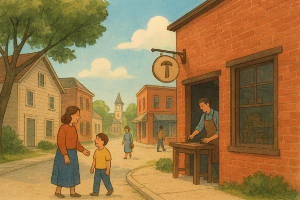
A structural map of the human‑scale institutions that once held life together.
I. Opening: What the Small World Actually Is
The small world is not a sentimental idea. It is a functional architecture, the set of human‑scale institutions that once held life together and made ordinary people capable of carrying responsibility. It is the world close enough to touch, small enough to understand, and stable enough to inhabit. It is where identity is formed, where norms are transmitted, and where the daily maintenance of life is shared among people who know one another.
For most of human history, the small world was not optional. It was the environment in which every person lived: families that spanned generations, apprenticeships that shaped character and skill, neighborhoods where reputation mattered, and traditions that provided continuity across time. These structures were not perfect, but they were load‑bearing. They gave people a place to stand.
Modern life has expanded far beyond this scale. People now live inside systems so large and abstract that they cannot see how those systems work or where they themselves fit within them. The result is a quiet disorientation: a sense of being unanchored, overwhelmed, or unnecessary. The large world can coordinate, distribute, and regulate, but it cannot form identity, cultivate responsibility, or transmit belonging. Those functions belong to the small world alone.
To understand what has been lost and what must be rebuilt, we must first understand the architecture of the small world itself. It is not a single institution, but a network of interlocking structures that operate at human scale. When these structures are strong, people become capable, connected, and oriented. When they weaken, the entire society becomes fragile.
This essay maps those structures. It traces the pillars of the small world, the environments in which they once thrived, and the consequences of their erosion. It also shows why the small world remains the only scale at which repair can begin and why its restoration is essential for any future worth inheriting.
II. The Four Pillars of the Small World
The small world is not a single institution. It is a network of interlocking structures that operate at human scale, each carrying a distinct part of the work of forming capable, oriented, responsible adults. These structures evolved over centuries because they matched the limits and needs of the human creature. When they function together, they create a world that is stable, comprehensible, and livable. When they weaken, the large world becomes impossible to navigate.
These pillars are not theoretical. They are practical. They are the places where people learn how to live.
1. Family — The Architecture of Identity
Family is the first institution and the most formative. It is where children learn who they are, long before they can articulate it. It is where norms are transmitted, where emotional grounding is established, and where the earliest responsibilities are practiced. Family is not merely a private arrangement; it is the foundation of social continuity. When families weaken, every other institution must compensate and none of them can.
2. Apprenticeship — The Architecture of Capability
Apprenticeship is the ancient pattern through which skill, judgment, and character are formed. It is not simply job training. It is the process by which a young person is brought into the adult world through guided participation in meaningful work. Apprenticeship binds generations together, preserves knowledge, and creates capable adults who know how to carry weight. Without it, societies produce people who are educated but unprepared, informed but unskilled.
3. Neighborhood — The Architecture of Norms
Neighborhood is the moral ecosystem of daily life. It is the environment where behavior is shaped by proximity, reputation, and shared expectations. In a functioning neighborhood, people know one another, watch over one another, and hold one another accountable. This is not surveillance; it is mutual responsibility. Neighborhoods teach cooperation, trust, and the quiet obligations that make communal life possible.
4. Tradition — The Architecture of Continuity
Tradition is the accumulated wisdom of what worked. It is not the worship of the past; it is the memory of successful experiments. Tradition stabilizes life across generations by providing patterns that reduce chaos and preserve meaning. It anchors people in a story larger than themselves and protects them from the drift that occurs when every generation must invent life from scratch.
These four pillars...family, apprenticeship, neighborhood, and tradition...form the architecture of the small world. They are not nostalgic artifacts. They are the structures that make human life coherent. When they are strong, people become capable and oriented. When they weaken, the large world becomes overwhelming.
The next section examines how these pillars take shape in different environments and why rural communities, in particular, remain the strongest surviving expression of the small world.
III. The Rural Expression of the Small World
Rural communities are often treated as peripheral to national life, but structurally they are anything but. They are the places where the small world still exists in its most intact form and the places where its erosion carries the greatest consequences. Rural towns remain the backbone of food production, energy systems, water networks, transportation corridors, and ecological stewardship. They are small in population, but large in function.
What distinguishes rural communities is not simply geography. It is continuity. Families remain in place for generations. Neighbors know one another by name. Work is shared, not abstracted. Identity is tied to land, craft, and lineage rather than to institutions or digital networks. These are the conditions under which the small world thrives: proximity, memory, and mutual responsibility.
Yet these same communities are also the first to feel the strain of a society that has expanded beyond its capacity to maintain itself. Rural infrastructure requires more miles of pipe, wire, and road per person than any other environment. It depends on manpower that is aging, thinning, or migrating away. When maintenance debt accumulates, rural regions are the first to be triaged, not because they matter less, but because they are harder to sustain at scale.
This creates a quiet but profound vulnerability. When a rural hospital closes, an entire region loses access to care. When a bridge collapses, supply chains slow across multiple states. When a substation fails, thousands of acres of farmland go dark. Rural decline is not a local problem. It is a national risk factor.
And yet, in the context of repair, rural towns hold a unique promise. They still possess the remnants of the small world: intergenerational memory, apprenticeship patterns, neighbor‑to‑neighbor responsibility, and a culture of shared work. These are the exact structures that must be rebuilt everywhere else. In a future where the large world becomes brittle, rural communities may become the prototypes of renewal. The places where local grids are restored, trades revived, and community governance strengthened.
Rural America is not the edge of the nation. It is the foundation. Its decline signals systemic fragility. Its restoration signals the beginning of repair.
IV. The Urban Expression of the Small World
Urban life is often described as the opposite of the small world, anonymous, transient, and overwhelming. But this was not always true. For most of the modern era, cities contained some of the strongest expressions of the small world: dense neighborhoods with stable families, local trades, intergenerational shops, religious communities, and street‑level networks of mutual responsibility. Density did not weaken the small world. It intensified it.
What changed was not the city itself, but the conditions under which urban life is lived. Mobility replaced continuity. Renting replaced rootedness. Digital networks replaced street‑level relationships. Work became detached from place. Neighborhoods turned over faster than norms could form. The result is a paradox: cities are full of people, yet many urban residents experience a profound sense of isolation.
The small world can exist in cities, but it requires stability. It requires neighbors who remain long enough to know one another. It requires local institutions that endure across generations. It requires apprenticeships that tie young people to the work of the city. It requires traditions that give shape to communal life. When these elements weaken, density becomes a liability rather than a strength.
Urban decline is often framed as a problem of crime, housing, or governance. But beneath these symptoms lies a deeper structural issue: the erosion of the small world. When families are unstable, when apprenticeships disappear, when neighborhoods lose continuity, and when traditions fade, the city becomes a place where people live near one another but not with one another. Proximity without relationship creates a form of social weightlessness.
Yet cities also hold immense potential for repair. Their density allows for rapid rebuilding of community architecture when the right structures are in place. Urban neighborhoods can revive local institutions, restore apprenticeship pathways, and rebuild the rhythms of shared life. The small world can return to the city, but only through intentional design, not through scale alone.
Urban and rural communities face different challenges, but the underlying architecture is the same. Both depend on the four pillars of the small world. Both weaken when those pillars erode. And both can become sites of renewal when those pillars are restored.
V. What Happens When These Pillars Weaken
When the pillars of the small world weaken, the effects are not immediate. They accumulate quietly, like maintenance debt in a system that still appears functional from a distance. But over time, the consequences become structural. A society built on human‑scale institutions cannot remain stable when those institutions erode.
The first consequence is disorientation. Without family continuity, apprenticeship pathways, neighborhood norms, or living traditions, people lose the structures that once told them who they are and how to live. Identity becomes fluid, but not in a liberating way, in a weightless way. People drift between roles, places, and commitments without ever feeling rooted.
The second consequence is fragility. Capability declines when apprenticeship disappears. Responsibility thins when neighborhoods lose continuity. Norms dissolve when tradition is treated as optional. A society that cannot form capable adults becomes dependent on distant systems to compensate, systems that cannot carry the full weight of human development.
The third consequence is overwhelm. When the small world collapses, people are forced to live primarily in the large world, a world too vast to navigate without the grounding of the small one. They experience life as a series of abstractions: global news, national politics, digital networks, economic forces. These are real, but they are not livable. Without the small world, the large world becomes a source of anxiety rather than orientation.
The fourth consequence is institutional brittleness. Schools, governments, workplaces, and civic organizations all depend on the small world to supply capable, oriented, responsible people. When the small world weakens, these institutions must absorb tasks they were never designed to perform: identity formation, emotional regulation, moral instruction, skill development. They strain under the weight.
And finally, the collapse of the small world produces a crisis of meaning. Human beings are not built to live without continuity, responsibility, or belonging. When these structures fade, people search for substitutes, often in ideology, consumption, or digital identity. These substitutes offer stimulation, but not grounding. They cannot replace the slow, steady work of the small world.
The weakening of the small world is not a cultural inconvenience. It is a civilizational risk factor. It destabilizes individuals, families, institutions, and entire regions. It makes the large world feel unmanageable because the structures that once made it navigable have thinned.
The next section turns toward the path of repair and explains why the small world is the only scale at which renewal can begin.
VI. Why the Small World Is the Only Scale Where Repair Can Begin
Repair is not a matter of policy or ideology. It is a matter of scale. Human beings are built to live, work, and form identity within structures that are close enough to touch. When life is anchored in the small world, the large world becomes navigable. When the small world collapses, the large world becomes overwhelming.
The small world is the only scale where repair can begin because it is the only scale where responsibility is visible. People can see the effects of their actions. They can feel the weight of their commitments. They can recognize the needs of others and respond to them directly. This visibility creates agency, the sense that one’s actions matter. Without agency, repair is impossible.
It is also the only scale where trust can form. Trust does not emerge from systems or slogans. It emerges from repeated interactions with people who share a place, a rhythm, and a set of expectations. Trust is the foundation of cooperation, and cooperation is the foundation of any functioning society. The small world is where trust is built, maintained, and transmitted.
The small world is also the only scale where capability can be formed. Skills are not learned in abstraction. They are learned through apprenticeship, repetition, and guided participation in meaningful work. A society that cannot form capable adults cannot maintain itself. The small world is the training ground for adulthood, the place where competence becomes character.
Finally, the small world is the only scale where meaning can take root. Meaning is not found in global movements or digital identities. It is found in the daily responsibilities that bind people to one another: caring for children, tending to land, maintaining homes, supporting neighbors, practicing traditions. These are the acts that give life coherence. They cannot be outsourced to institutions or scaled across continents.
The large world depends on the small one. It cannot replace it. When the small world is strong, the large world becomes manageable. When the small world weakens, the large world becomes chaotic. Repair must begin where human beings actually live, in families, neighborhoods, apprenticeships, and traditions. These are the structures that make renewal possible.
VII. Closing: The Small World as the Foundation of Renewal
The small world is not a relic of the past. It is the foundation on which any livable future must be built. A society can innovate, expand, and modernize, but it cannot outgrow the human scale. People still need identity, continuity, responsibility, and belonging...and these can only be formed in the structures closest to them.
The large world will always be complex. It will always demand coordination, governance, and systems that operate far beyond the reach of any individual. But the ability to navigate that world depends on the strength of the small one. When families are stable, apprenticeships alive, neighborhoods connected, and traditions practiced, people can face the large world without being overwhelmed by it. They have a place to stand.
Repair begins by rebuilding these foundations. It begins with the institutions that operate at human scale, the relationships that carry meaning, and the responsibilities that bind people to one another. It begins in the places where life is actually lived, in homes, workshops, streets, and rituals. These are the structures that form capable adults, sustain communities, and transmit wisdom across generations.
Rural towns may become the first sites of renewal, not because they are untouched by decline, but because they still possess the remnants of the small world. Urban neighborhoods can be rebuilt with intention, restoring the continuity and cooperation that once made them strong. Across both environments, the work is the same: to restore the architecture that makes human life coherent.
The small world is not a retreat from the large one. It is the only scale at which repair can begin, and the only foundation on which a stable, meaningful, and durable society can be built. The rest of this series will examine each pillar in depth, tracing its history, its erosion, and the path toward renewal.
The future will not be repaired from the top down.
It will be rebuilt from the small world outward.