Neighborhood
A neighborhood is the smallest public world, where private life becomes shared life. When its physical and social infrastructures weaken, belonging fades and big‑world problems rush in. Repair begins by restoring community at a human scale.
How the Smallest Public World Holds a Society Together
I. The Smallest Public World
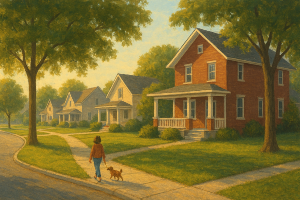
A neighborhood is the first place where private life becomes shared life. It is the smallest public world a person inhabits, the space just beyond the front door where family identity meets community reality. Children step into it long before they understand its structure. They learn its boundaries by walking its sidewalks, hearing its sounds, and recognizing the faces that appear again and again. Adults inhabit it with a different awareness, but the principle is the same: the neighborhood is where people become visible to one another.
In a functioning small world, the neighborhood is not an accident of geography. It is a living environment shaped by the people who occupy it. It has texture, memory, and expectation. It is the place where capability and character begin to matter socially, because neighbors see how you live, how you carry yourself, and how you treat others. It is the first arena where responsibility becomes public.
A neighborhood is not merely a collection of houses. It is a shared world with its own rhythms and norms. It is where children learn how to navigate conflict, where adults learn how to cooperate, and where families learn how to belong. It is the environment that turns strangers into neighbors and neighbors into a community. When it works, it becomes the quiet foundation of civic life. The scale at which people can actually know one another, care for one another, and hold one another accountable.
II. The Physical Infrastructure of the Neighborhood
Every neighborhood rests on a physical foundation that most people rarely think about until something breaks. The roads that carry children to school, the power lines that keep homes warm, the water systems that make daily life possible, the buildings that shelter families and businesses, all of these depend on steady, competent maintenance. This work is not abstract. It is physical, demanding, and often dangerous. And for most of history, it has been carried out by men.
In the small world, this was not a matter of ideology but of pattern. Boys grew up watching men repair roofs, clear fallen branches, fix engines, and keep the neighborhood’s physical environment in working order. They saw responsibility expressed through action: a willingness to step in, to lift, to build, to maintain. The neighborhood’s stability depended on this quiet, continuous labor. When the physical world was cared for, everything else had room to function.
The presence of capable men created a sense of predictability. Fewer things fell into disrepair. Fewer emergencies spiraled into crises. The neighborhood felt safe not because danger was absent, but because someone could handle it. Children absorbed this without being told. They learned that adulthood involved competence, steadiness, and the ability to take responsibility for the world around them.
This physical infrastructure was the first layer of public trust. It signaled that the neighborhood was not just a collection of houses but a maintained environment, a place where people took responsibility for what they shared. It was the groundwork upon which community life could be built.
III. The Social Infrastructure of the Neighborhood
If the physical world of a neighborhood is held together by maintenance and repair, the social world is held together by relationships, coordination, and care. This work is quieter, less visible, and often taken for granted, yet it is no less foundational. It is the operating system of community life, the network of human connections that makes a neighborhood feel like a place rather than a grid of houses.
Historically, this infrastructure was built and sustained by women. They organized the PTA meetings that connected families to schools. They coordinated church events, meal trains, and neighborhood gatherings. They kept track of who was struggling, who needed help, and who had just welcomed a new child. They created the informal support systems that allowed families to weather hardship without collapsing. Their work gave the neighborhood its memory, its continuity, and its sense of belonging.
This was not merely “volunteering.” It was civic leadership at the human scale. It required judgment, relational intelligence, and the ability to hold a community together through attention and care. Girls learned these skills by watching their mothers navigate the social world with competence and grace. They saw how relationships were maintained, how conflicts were softened, and how a community could be shaped through steady, patient effort.
When this social infrastructure is strong, a neighborhood becomes more than a place to live. It becomes a shared world with expectations, rhythms, and a sense of mutual responsibility. People know one another. Children grow up surrounded by adults who care about them. Families feel supported rather than isolated. The neighborhood becomes a buffer against the instability of the larger world.
This relational architecture is as essential as the physical one. Without it, the neighborhood loses its cohesion. People retreat indoors. Families drift. Children grow up without the web of relationships that once anchored them. The social world becomes thin, and the neighborhood becomes a place where people live but do not belong.
IV. How the Two Infrastructures Interlocked
A neighborhood works when its physical and social infrastructures reinforce one another. The material world provides stability; the relational world provides cohesion. One without the other is incomplete. Together, they create the environment in which people can live, grow, and take responsibility for one another.
The physical infrastructure...the roads, utilities, buildings, and maintenance...gives the neighborhood its reliability. It ensures that daily life is predictable, that crises are manageable, and that the environment itself is not a source of constant stress. This stability creates the conditions in which relationships can form and endure. People are more willing to invest in a place when they trust that it will hold.
The social infrastructure...the networks of care, coordination, and community leadership...gives the neighborhood its meaning. It turns proximity into belonging. It creates the rhythms of shared life: the school events, the church gatherings, the informal support systems that help families through illness, loss, or hardship. This relational architecture makes the neighborhood more than a location; it makes it a community.
When these two infrastructures interlock, the neighborhood becomes a training ground for adulthood. Children learn how to navigate conflict because they see adults resolving it. They learn cooperation because they watch neighbors help one another. They learn accountability because their actions have consequences in a world where people know their names. The neighborhood becomes the first place where character is tested and shaped in public.
This interdependence is what made the small world resilient. The physical world supported the social world, and the social world gave purpose to the physical one. The neighborhood became a place where people could rely on one another, not because of ideology or policy, but because shared life made responsibility unavoidable. It was the smallest scale at which a society could function and the most important.
V. What Happens When the Neighborhood Collapses
When the neighborhood weakens, the collapse is rarely dramatic. It begins quietly, almost imperceptibly, as the two infrastructures that once held the small world together start to thin. The physical world becomes less reliable; the social world becomes less cohesive. What was once maintained through proximity and shared responsibility now drifts into neglect.
The physical infrastructure weakens first in small ways: fewer men enter the trades, fewer apprentices learn from experienced workers, fewer neighbors know how to fix what breaks. The work becomes distant, outsourced, or invisible. The neighborhood loses the steady presence of capable men who once kept the environment predictable. Without this foundation, the physical world becomes fragile. Breakdowns take longer to repair. Emergencies become more disruptive. The neighborhood feels less safe, not because danger has increased, but because competence has thinned.
The social infrastructure erodes in parallel. The civic spaces where women once led...the PTA, the church committees, the neighborhood associations...shrink or disappear. Families become more isolated. The informal networks that once supported single parents, new mothers, the elderly, and the struggling begin to dissolve. Without these relational structures, the neighborhood loses its cohesion. People retreat indoors. Children grow up without the web of adults who once watched over them. The social world becomes thin, and the neighborhood becomes a place where people live but do not belong.
As these two infrastructures weaken, the neighborhood loses its ability to absorb the pressures of the larger world. Problems that were once handled locally...conflict, hardship, instability...now escalate into “big world” issues. Policing becomes impersonal. Racial tension becomes abstract. Family instability becomes a statistic rather than a shared concern. The neighborhood no longer functions as a buffer. It becomes porous, fragile, and reactive.
This collapse is not the result of a single cause. It is the cumulative effect of a society that has shifted its attention away from the small world and toward the large one. When the neighborhood is no longer the center of daily life, both the physical and social infrastructures that sustained it begin to fail. And without them, the small world cannot hold.
VI. The Civic Stakes
A society cannot function when its neighborhoods fail. The neighborhood is the smallest scale at which public life becomes real, the place where responsibility is visible and shared. When it works, it absorbs pressures that would otherwise overwhelm families and institutions. When it collapses, those pressures spill outward into the large world, where they become abstract, polarized, and unmanageable.
The large world can deliver services, but it cannot form people. It cannot teach children how to belong, how to cooperate, or how to resolve conflict. It cannot replace the steady presence of capable men who maintain the physical world, nor the relational leadership of women who sustain the social world. These forms of work are not interchangeable, and they cannot be outsourced to distant institutions. They require proximity, familiarity, and a sense of shared life.
Rebuilding neighborhoods means rebuilding both infrastructures. It means restoring the dignity of the physical work that keeps the world standing and the relational work that keeps the community whole. It means giving children a place where they are known, where adults model responsibility, and where families are supported rather than isolated. It means returning to a scale of life where people can see the consequences of their actions and the value of their contributions.
The neighborhood is not a nostalgic ideal. It is a civic necessity. It is the environment in which the small world becomes visible and the foundation upon which the large world depends. When the neighborhood is strong, society has a chance to repair itself. When it is weak, no amount of policy or ideology can compensate for what has been lost.
The path to renewal begins here, at the smallest public scale, where people live side by side and learn how to hold a world together.