Essay 3: The Family as the First Institution
The family is the first institution of any stable society. It forms identity, anchors belonging, and prepares the next generation for responsibility. When families weaken, the small world collapses. Repair begins at home.
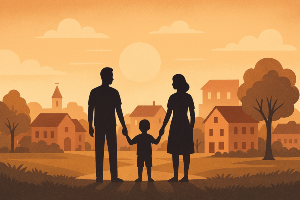
How identity, grounding, and responsibility are formed at human scale.
I. Opening: Family Is Not a Sentiment — It Is an Institution
Every society depends on the family to perform work that no other institution can do. It is the first structure that forms identity, the first environment that teaches responsibility, and the first community where belonging becomes real. Long before a child encounters schools, workplaces, or the wider world, the family has already shaped the foundations of who they are.
In the modern era, family is often treated as a lifestyle preference...one option among many, something private and personal rather than structural and civic. But the family is not a private hobby. It is the first institution of any functioning society, and when it weakens, every other institution inherits work it cannot perform. Schools attempt to replace formation. Workplaces attempt to replace community. Governments attempt to replace responsibility. None of them can succeed at scale.
The collapse of family formation is not simply a cultural shift; it is a structural failure. High divorce rates, delayed marriage, declining birth rates, and the ease with which families dissolve have created a generation of adults formed without the stability that previous eras took for granted. And because families are the first site of apprenticeship, continuity, and moral formation, their weakening produces downstream fragility in every domain...from workforce participation to community cohesion to national identity.
Men and women are equal in dignity, but they are not identical in design. Families have always depended on complementary roles...different strengths, different forms of responsibility, different ways of anchoring the home and connecting it to the larger world. This complementarity is not ideological; it is functional. When it collapses, the institution loses its load‑bearing capacity. A society that promotes individual advancement without also promoting marriage, commitment, and family formation eventually finds itself unable to maintain the very systems that make modern life possible.
The family is the first architecture of the small world. It is where identity is formed, where grounding is established, and where responsibility becomes a lived practice rather than an abstract ideal. If the small world is the scale at which repair must begin, then the family is the foundation on which that repair rests.
II. The Work Only Families Can Do
A society can build schools, workplaces, governments, and digital networks, but none of these can perform the foundational work that families carry out as a matter of daily life. Families are not symbolic. They are functional. They are the first environment where human beings learn who they are, how to live, and what it means to belong to others. When this work is strong, the rest of society becomes manageable. When it weakens, every other institution is forced to compensate and none of them can.
1. Identity Formation
Identity is not formed through ideology or curriculum. It is formed through the earliest relationships, the voices, rhythms, and expectations that shape a child long before they understand the world. Family provides the first story a person hears about themselves: where they come from, who they belong to, what kind of life they are part of. This early identity becomes the anchor for everything that follows.
2. Emotional Grounding
Human beings need stability before they need opportunity. The nervous system is shaped by predictability, attachment, and the presence of adults who provide continuity. No scaled institution can replicate this. Emotional grounding is not a service; it is a relationship. When families weaken, children grow up without the internal ballast that allows them to face difficulty, delay gratification, or form durable commitments.
3. Norm Transmission
Families are the first moral ecosystem. They teach reciprocity, self‑control, cooperation, and the difference between right and wrong. These norms are not taught through lectures; they are absorbed through participation in daily life. When families weaken, society attempts to outsource norm transmission to schools, courts, and workplaces, institutions that were never designed for it.
4. Responsibility Training
Responsibility is not learned through abstraction. It is learned through contribution: small tasks that grow into shared work, and shared work that grows into capability. Families are the first apprenticeship in responsibility. They teach children that they are needed, that their actions matter, and that they are part of something larger than themselves. This early training becomes the foundation for adulthood.
5. Complementarity in Practice
Families function because men and women bring different strengths to the work of formation. Mothers and fathers anchor different dimensions of identity, grounding, and responsibility. This is not ideology; it is the pattern that has emerged across cultures because it works. Complementarity is not hierarchy, it is interdependence. When these roles weaken or become optional, the institution loses its load‑bearing capacity, and the next generation enters adulthood without the formation previous generations took for granted.
III. Complementarity: Why Families Are Built on Differentiated Roles
Families have always depended on the cooperation of two different kinds of strength. Across cultures and eras, men and women have carried distinct parts of the work of formation...not because one is superior to the other, but because human life requires a range of capacities that no single individual can embody alone. Complementarity is not a social invention. It is a structural reality that emerges wherever human beings attempt to build stable households and raise capable children.
Men and women are equal in dignity, but they are not identical in design. Their differences...biological, emotional, and behavioral...are not obstacles to overcome but resources to draw from. Mothers anchor the earliest forms of attachment, continuity, and emotional grounding. Fathers anchor boundary‑setting, external responsibility, and the bridge between the home and the larger world. These patterns are not stereotypes; they are functional roles that have persisted because they meet real human needs.
In a healthy family, these roles interlock like puzzle pieces. Each partner brings strengths that compensate for the other’s weaknesses, creating a whole that is stronger than either could produce alone. This interdependence is the foundation of stability. It gives children a full spectrum of formation: tenderness and firmness, nurture and discipline, belonging and aspiration. When these roles are present and aligned, the family becomes a resilient institution capable of transmitting identity, responsibility, and capability to the next generation.
When complementarity weakens, the institution itself becomes fragile. The rise of easy exit, the normalization of dissolution, and the cultural pressure to treat family as optional have eroded the load‑bearing structure that once held communities together. A society that encourages individual advancement without also promoting marriage, commitment, and the shared work of family formation eventually finds itself unable to produce the stable adults it needs. The result is a generation formed without the full architecture of identity, grounding, and responsibility and a society increasingly dependent on external systems to compensate for what families once provided.
Complementarity is not about enforcing roles. It is about recognizing that families function best when men and women bring their distinct strengths into a shared life. It is the architecture that allows the small world to exist at all.
IV. The Family as the First Apprenticeship
Before a child ever encounters formal schooling or the workplace, they have already spent years inside the most important apprenticeship they will ever receive. Families are the first environment where children learn how to participate in the world, not through lectures or programs, but through imitation, observation, and shared work. This early apprenticeship is where capability begins.
Children learn by watching adults do real things. They see meals prepared, repairs made, schedules kept, conflicts resolved, and responsibilities carried. They absorb the rhythms of adult life long before they can articulate them. In a healthy family, this apprenticeship is not staged or ceremonial; it is woven into the ordinary tasks that keep a household functioning. A child who participates in this work learns that they are needed, that their actions matter, and that competence is built through contribution.
Mothers and fathers model different forms of capability. Children learn tenderness, patience, and continuity from one parent; they learn boundary‑setting, external responsibility, and courage from the other. These are not stereotypes, they are functional patterns that have emerged across cultures because they prepare children for the full range of adult life. When both forms of capability are present, children grow into adults who can navigate both the interior and exterior demands of the world.
This domestic apprenticeship is the foundation of all later skill formation. Schools can teach information, and workplaces can teach technique, but neither can replace the early formation that teaches a child how to show up, how to persist, how to take responsibility, and how to contribute to something larger than themselves. When families weaken, this apprenticeship disappears, and society attempts to replace it with programs, interventions, and institutions that cannot replicate the intimacy or continuity of the home.
A society that loses domestic apprenticeship loses the first step in the formation of capable adults. And without capable adults, no amount of policy, funding, or external labor can sustain the systems that modern life depends on. The family is the first workshop of the small world, the place where competence begins.
V. The Family as the First Community
Families do not exist in isolation. They are embedded in neighborhoods, congregations, kin networks, and the informal webs of support that make life livable. These networks form the first layer of community, the human‑scale environment where continuity, accountability, and shared memory take root. When families are strong, communities become stable. When families weaken, the entire social ecosystem becomes thin, transient, and fragile.
A healthy community is built on predictable relationships. Neighbors know one another. Children grow up with familiar adults. Elders pass down stories, skills, and expectations. This continuity creates a moral ecology: a shared sense of what is normal, what is acceptable, and what is required. Families anchor this ecology by providing the first experience of belonging, and communities reinforce it by extending that belonging outward.
Mothers and fathers play different roles in this ecosystem. Mothers often anchor the internal cohesion of community life, the relationships, the rhythms, the social glue that holds people together. Fathers often anchor the external responsibilities, the maintenance, the protection, the work that connects the household to the larger world. These patterns are not ideological; they are functional. They create a balance between nurture and structure, between intimacy and responsibility, between the home and the public square.
When these roles weaken, communities lose their foundation. Neighborhoods become transient. Social trust declines. The informal networks that once supported families disappear, and institutions are forced to take on responsibilities they cannot fulfill. Schools become surrogate families. Police become surrogate fathers. Social programs become surrogate communities. None of these substitutions can replicate the stability that emerges naturally when families and neighborhoods are aligned.
Unpredictable population shifts...whether from internal migration, economic displacement, or unmanaged inflow...strain communities that are already fragile. Community life depends on continuity, and continuity depends on families that remain rooted long enough to build relationships, transmit norms, and maintain the shared spaces that make neighborhoods feel like home. When the small world thins out, the larger world becomes unmanageable.
The family is the first community not because it is small, but because it is stable. It is the structure that allows neighborhoods to function, traditions to persist, and civic life to remain grounded in human-scale relationships. Without strong families, communities cannot hold.
VI. What Happens When Family Weakens
When the first institution weakens, the effects do not remain contained within the home. They ripple outward into every layer of society, reshaping the workforce, the community, and the national infrastructure. A society can survive economic shocks, political cycles, and technological disruption, but it cannot survive the collapse of the structures that form human beings. The weakening of family formation is not a private matter. It is a civilizational event.
1. Identity Becomes Unanchored
Without the early grounding that families provide, identity becomes fragile and easily captured by ideology, consumption, or digital life. People search for belonging in abstractions because they did not receive it in the relationships that were meant to form them. A society full of unanchored individuals becomes volatile, anxious, and easily fragmented.
2. Capability Declines
When domestic apprenticeship disappears, adulthood becomes delayed or brittle. Young people enter the world without the habits of responsibility that previous generations absorbed through participation in family life. Work becomes overwhelming. Commitment becomes frightening. The basic competencies that sustain a society...showing up, following through, contributing to shared work...become rare rather than expected.
3. Institutions Become Overburdened
As families weaken, schools, workplaces, and governments inherit responsibilities they were never designed to carry. Schools attempt to teach norms. Workplaces attempt to provide community. Governments attempt to supply stability. These institutions strain under the weight of tasks that only families can perform. The result is burnout, bureaucratic expansion, and a growing sense that nothing works the way it should.
4. Loneliness and Drift Increase
Humans are not built to form themselves alone. When families weaken, people lose the first experience of belonging, and communities lose the continuity that makes relationships durable. Loneliness becomes widespread, and drift becomes normal. A society full of isolated individuals cannot sustain the shared commitments that civic life requires.
5. The Collapse of Complementarity
When the partnership between men and women becomes fragile, the institution itself loses its load‑bearing capacity. High divorce rates, delayed marriage, and the ease of dissolution create instability that cascades into every domain. Children grow up without the full architecture of formation. Adults enter the world without the grounding that complementarity provides. The result is a generation formed without the structural advantages that once made communities resilient.
6. Dependence on External Labor Increases
A society that cannot form its own people becomes dependent on external labor to fill the gaps. Immigration can supplement, but it cannot replace the formation of capable adults. And when population growth becomes unpredictable...whether through internal migration, economic displacement, or unmanaged inflow...infrastructure strains under loads it was never designed to carry. The manpower crisis is not simply a shortage of workers. It is the downstream effect of a society that has lost the ability to form its own.
7. The Small World Collapses
When families weaken, neighborhoods thin out, apprenticeship disappears, and tradition loses continuity. The small world...the human‑scale environment where identity, capability, and belonging are formed...collapses. And when the small world collapses, the large world becomes unmanageable. No policy, program, or external system can replace the architecture that families once provided.
VII. Why Repair Must Begin with the Family
If the family is the first institution, then it must also be the first site of repair. No society can rebuild its workforce, its communities, or its sense of continuity without rebuilding the structure that forms human beings in the first place. Every downstream crisis, from the manpower shortage to the collapse of apprenticeship to the thinning of community life, traces back to the weakening of the home. Repair begins where formation begins.
A society that promotes education and career but neglects marriage and family formation creates an imbalance it cannot sustain. Individual advancement is good, but it cannot replace the shared work of building a household, raising children, and transmitting identity across generations. When family becomes optional, fragile, or secondary, the entire social architecture becomes brittle. The systems that depend on stable families...schools, trades, neighborhoods, civic institutions...begin to strain under loads they were never designed to carry.
Rebuilding the family does not mean returning to a past era or enforcing rigid roles. It means restoring the functional architecture that allows men and women to build a life together, raise children with stability, and contribute to the communities that depend on them. It means recognizing that complementarity is not a constraint but a resource, the interlocking strengths that make a household resilient and a community durable.
Repair also requires cultural honesty. A society cannot rely indefinitely on external labor to compensate for its own collapse in formation. Immigration can enrich and supplement, but it cannot replace the domestic apprenticeship that produces capable adults. Nor can it substitute for the continuity that families and communities provide. A nation that cannot form its own people eventually loses the ability to maintain its own systems. Repair must begin with the structures that create stability, not with the systems that attempt to manage instability.
Rebuilding the family is not a private project. It is a civic one. It is the foundation on which every other form of repair depends. When families are strong, communities become stable, apprenticeships flourish, and the next generation enters adulthood with the identity, grounding, and capability that modern life requires. When families weaken, no amount of policy or external intervention can compensate.
The small world begins at home. And if the small world is where repair must happen, then the family is the first institution to restore.
VIII. Closing: The Family as the Foundation of the Future
The family is not a relic of an earlier era. It is the first architecture of human life...the structure that forms identity, anchors belonging, and prepares the next generation for the responsibilities of adulthood. Every society that has endured has done so because its families were strong enough to transmit stability across time. Every society that has faltered has done so because the first institution weakened faster than the others could compensate.
Repairing the family is not about nostalgia or ideology. It is about restoring the functional structures that make a society capable of sustaining itself. It is about recognizing that the work of formation cannot be outsourced, automated, or imported. It must be done at home, in the daily rhythms of shared life, through the complementary strengths of men and women who commit to building something larger than themselves.
The small world begins with the family. It is the foundation on which apprenticeship, community, and tradition rest. When the family is strong, the other pillars rise naturally. When the family weakens, the entire structure becomes unstable. The manpower crisis, the collapse of apprenticeship, the thinning of community life, all of these are downstream effects of a society that has forgotten where formation begins.
But the architecture is still there. The path to renewal is not mysterious. It begins with rebuilding the first institution: restoring commitment, strengthening complementarity, and giving the next generation the grounding they need to become capable adults. If the small world is the scale at which repair must happen, then the family is the place where that repair becomes real.
The next essay will turn to the second pillar, apprenticeship, the structure that transforms grounding into capability, and identity into contribution. If the family forms the person, apprenticeship forms the worker, the citizen, and the steward. Together, they create the human foundation on which every society depends.